
Stay tuned on LinkedIn to be the first to hear about our updates!
Quick Answer A B2B company is ready to build a partner ecosystem when it has a repeatable sales motion, a product that delivers consistent results, internal alignment on ecosystem as a growth channel, dedicated capacity to run it, and a direct sales motion that already generates revenue. These are company conditions. All five need to be in place before the ecosystem work begins.
Why Most B2B Companies Ask the Wrong Readiness Question
The most common version of the readiness question sounds like this: are we big enough yet? Do we have enough revenue? Should we wait until we hire a head of partnerships?
These are timing questions. They assume readiness is a stage you reach rather than a state you build. And that assumption is why so many partner ecosystems launch too early, underdeliver, and quietly get deprioritized within the first year.
The right question is not when. It is whether.
Whether your company has the internal conditions that allow a partner ecosystem to survive and grow. Those conditions have nothing to do with your ARR, your headcount, or your funding round. A Series A company with the right internal structure will build a stronger ecosystem faster than a Series B company missing two of the five conditions below.
Stage is not the variable. Structure is.
What Partner Ecosystem Readiness Actually Means
Partner ecosystem readiness is the state in which a B2B company has the internal foundation for a partner ecosystem to operate without collapsing.
It is worth being precise about what this means, because the term gets used loosely. Readiness is not the same as having a partner program. It is not the same as having a partnerships hire. It is not about having the right tools or the right commission structure. Those are program elements. They come later.
Readiness has three stages, and most companies try to skip to the third:
Ready to build: The company has the internal conditions to start constructing an ecosystem. Sales motion is clear, product delivers consistent results, leadership is aligned. This is where the five conditions apply.
Ready to launch: The program infrastructure exists. Partner types are defined, terms are documented, the program is visible to potential partners. This follows readiness to build.
Ready to scale: Early partners are active, attribution is tracked, and the program has demonstrated results worth investing in further. This follows a successful launch.
Most companies that struggle with partner ecosystems are attempting to scale before they have finished building. The five conditions in this article determine whether you are ready to start at all.
The Cost of Launching Before You Are Ready
Launching a partner ecosystem before the company conditions are in place does not just produce slow results. It produces specific, predictable failure modes that are worth understanding before you invest time and budget.
Partners sign up and go silent.
If your sales motion is unclear, partners have no reliable way to position you to their clients. They test it once or twice, get confused responses, and quietly deprioritize you in favor of vendors they can sell more easily.
The first referred deal goes badly.
If your product outcomes are inconsistent, the partner who referred that deal takes the reputational hit with their client. Most will not refer a second deal.
The sales team resists.
Without internal alignment, your own sales team may see partners as competition for pipeline rather than an extension of it. Deals get stalled, credit gets disputed, and partners stop engaging.
No one measures anything.
Without dedicated capacity and ownership, attribution tracking never gets set up. Six months in, no one can answer whether the program is working. Budget justification becomes impossible and the program loses executive support.
The executive sponsor loses interest.
Without a clear owner driving consistent activity, partner programs tend to go quiet between quarters. One quarter with no visible results is often enough for leadership to redirect the investment.
None of these are market failures. They are internal failures. The program launched before the company was ready.
The 5 Conditions for Partner Ecosystem Readiness
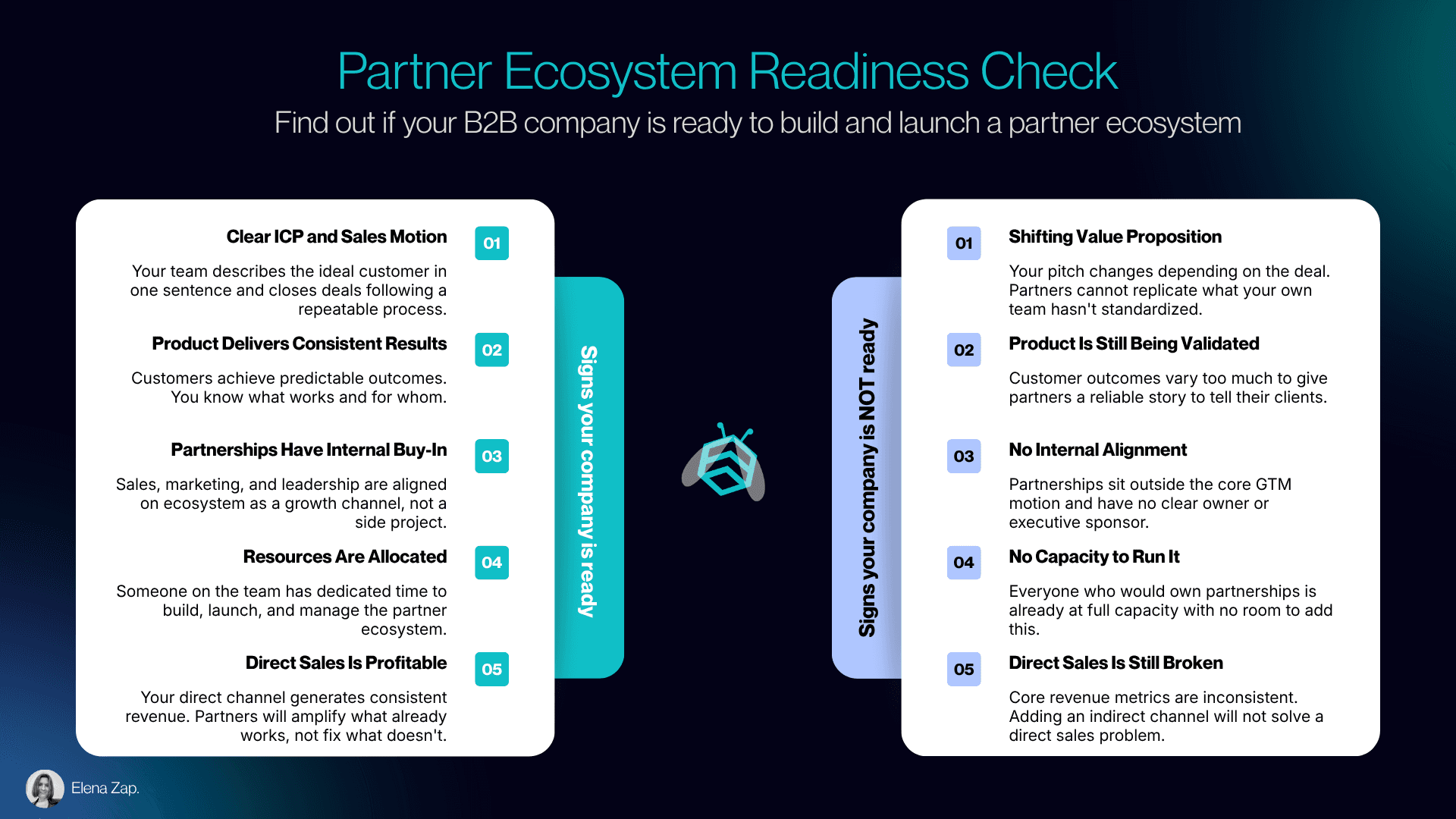
Condition 1: Clear ICP and Sales Motion
Partners can only sell what your own team has already proven it can sell.
A repeatable sales motion does not need to be perfect. It needs to be consistent enough that someone outside your company can follow it. That means one clearly defined ideal customer profile, a documented process from first conversation to close, and a value proposition that does not shift depending on who is selling or who is buying.
The diagnostic question: can every person on your team describe your ideal customer in one sentence, the same sentence? If different people give different answers, partners will encounter the same inconsistency. They will not know how to position you. Most will stop trying after the first awkward client conversation.
The signal that this condition is missing: your close rate varies significantly across deals with no clear pattern, or your team regularly adjusts the pitch based on what the prospect seems to want to hear.
Condition 2: Product Delivers Consistent Results
Every time a partner introduces you to a client, they are staking their professional reputation on the outcome.
Partners do not need you to have dozens of case studies. They need enough customers in a similar profile to establish a clear, repeatable pattern: you know what works, for whom, and under what conditions. That pattern is the story a partner tells their client when they make the introduction. Without it, the partner is taking a risk they cannot quantify.
The diagnostic question: can you name five customers who achieved a similar outcome using your product, and can you describe what they had in common?
The signal that this condition is missing: customer outcomes vary significantly across accounts, onboarding frequently runs over schedule, or you regularly hear from customers that the product did not perform as expected.
Condition 3: Partnerships Have Internal Buy-In
A partner ecosystem without internal buy-in will not survive its first year.
Internal alignment means three things. First, leadership treats ecosystem as a real growth channel with a named owner and a budget, not a project that happens alongside everything else. Second, the sales team understands that partners extend the pipeline rather than compete with it. Third, marketing is prepared to support partner-facing content and visibility, not just direct demand generation.
Without executive sponsorship, partner programs get deprioritized the moment a direct sales quarter gets difficult. That moment will come. The program needs to be anchored by someone with enough authority to protect it.
The diagnostic question: who in your company owns the outcome of the partner ecosystem, and do they have the authority to protect the investment when other priorities compete for the same resources?
The signal that this condition is missing: partnerships is described as a marketing or sales initiative rather than a company growth priority, or no executive has a personal stake in the outcome.
Condition 4: Resources Are Allocated
Building a partner ecosystem requires consistent, dedicated attention across recruitment, onboarding, enablement, and relationship management. None of these happen reliably when they are added to someone's existing full-time role.
This condition does not require a full-time head of partnerships from day one. It requires that the person responsible has genuine capacity to do the work. That means protected time, not time that disappears when something more urgent arrives. It also means the capacity is visible to partners. When a potential partner asks who manages the program and gets a vague answer, they draw the correct conclusion: this program is not a priority.
The diagnostic question: who specifically is responsible for the partner ecosystem, and how many hours per week do they have allocated to it with no competing obligations?
The signal that this condition is missing: the person nominally responsible for partnerships also runs demand generation, manages the SDR team, or holds another full-time responsibility that will always take precedence.
Condition 5: Direct Sales Is Profitable
Partners amplify what already works. They do not fix what does not.
A partner ecosystem adds a second distribution layer on top of your existing direct motion. If the direct motion is generating consistent, profitable revenue, partners multiply it. If the direct motion is inconsistent or unprofitable, adding indirect channels introduces complexity without addressing the underlying problem. You will be asking partners to sell something your own team has not yet figured out how to sell reliably.
The diagnostic question: is your direct sales motion generating predictable, profitable revenue month over month, and does your team understand clearly why each deal closes?
The signal that this condition is missing: monthly revenue varies significantly without a clear explanation, average deal size is inconsistent, or your team cannot articulate why some deals close and others do not.
How the 5 Conditions Relate to Each Other
The five conditions are not an independent checklist where four out of five is close enough. They interact with each other, and some combinations are more dangerous than others.
Conditions 1 and 2 are hard prerequisites. Without a clear ICP and consistent product results, no other condition compensates. Partners cannot sell what they cannot understand, and they will not risk their reputation on a product with unpredictable outcomes.
Condition 3 without condition 4 is a promise with no execution. Leadership buy-in creates the mandate. Allocated resources are what actually runs the program. Many companies have enthusiastic executive sponsors who never protected the capacity needed to deliver.
Condition 5 without conditions 1 and 2 means you have revenue but partners cannot replicate how you got it.Strong direct sales numbers give false confidence that the company is ready. But if the sales motion is founder-led or relationship-dependent rather than documented and repeatable, partners have nothing to follow.
The most dangerous combination is conditions 1, 2, and 5 met while 3 and 4 are missing.
Companies in this state launch confidently, attract some early partner sign-ups, and then watch the program quietly stall as internal resistance and lack of ownership erode it over the following quarters. By the time the failure is visible, the narrative has already formed: partnerships just does not work for us.
Read more: How to Build a Partner Marketing Strategy That Actually Drives Pipeline
Readiness by Company Stage
Stage does not determine readiness, but it does predict where the gaps are most likely to be. This table is a reference point, not a prescription.
Stage | Typical readiness gaps | Where to focus first |
|---|---|---|
Pre-seed / Seed | ICP not defined, product still being validated | Conditions 1 and 2 only. Do not start ecosystem work yet. |
Series A | Sales motion emerging, internal alignment weak, no dedicated capacity | Conditions 1, 2, and 3. Get alignment before allocating resources. |
Series B | All conditions potentially met, but capacity is often still spread across roles | Condition 4 first, then assess the others and launch. |
Series B+ with stalled program | Program exists but is underperforming | Reassess all five. Stalled programs almost always trace back to condition 3 or 4. |
The Readiness Mistake Most B2B Companies Make
The most common mistake is treating readiness as something that arrives rather than something that gets built.
Founders defer the ICP conversation because the product is still evolving. They defer the alignment conversation because leadership is focused on the next funding round. They defer the capacity question because everyone is already stretched. Each deferral feels reasonable in isolation. Collectively, they add up to a partner ecosystem that never quite gets off the ground.
The compounding cost of this delay is underappreciated. A partner ecosystem builds authority over time. Early partners generate the first proof points that attract better partners. Program visibility in search and AI engines accumulates month over month. A company that starts building six months earlier than a competitor does not just get a six-month head start. It gets a compounding advantage that is increasingly difficult to close.
Waiting for the right moment is not a neutral choice. It is a choice to let a competitor build the compounding advantage first.
Readiness is built, not reached. The five conditions above are all within your control. None of them require a funding event, a new hire, or a product release. They require decisions and consistent work. That work can start today.
How to Assess Your Company's Readiness Today
Go through each condition. For each one, answer the diagnostic question honestly. The goal is not a score. It is clarity on where the gaps are and what to address first.
Condition 1 — ICP and sales motion: Can every person on your team describe your ideal customer in one sentence, the same sentence? If not, define it before anything else.
Condition 2 — Product results: Can you name five customers who achieved a similar outcome and describe what they had in common? If not, gather that evidence from existing customers before recruiting partners.
Condition 3 — Internal alignment: Who owns the ecosystem outcome with their name on it, and do they have executive authority to protect it? If no one can answer that question clearly, alignment work comes before program work.
Condition 4 — Allocated resources: Who is responsible for partnerships, and how many protected hours per week do they have? If the answer is vague, the capacity problem will surface within weeks of launch.
Condition 5 — Direct sales: Is your direct motion generating consistent, profitable revenue that your team can explain and replicate? If not, stabilize the direct motion before adding an indirect layer.
If you have clear answers to all five, your company is ready to build. If one or two are missing, you know exactly where to focus before the ecosystem work begins.
Quick Reference
Partner ecosystem readiness: The state in which a B2B company has the internal conditions to launch and sustain a partner ecosystem.
The 5 conditions: Clear ICP and sales motion, product delivers consistent results, partnerships have internal buy-in, resources are allocated, direct sales is profitable.
Conditions 1 and 2 are hard prerequisites. Nothing else compensates for their absence.
The most dangerous gap: Conditions 3 and 4 missing while 1, 2, and 5 are met. Programs in this state launch confidently and fail quietly.
The most common mistake: Treating readiness as a stage to reach rather than a set of conditions to build.
Readiness is built, not reached. Every condition is within your control today.
FAQ
What does partner ecosystem readiness mean for a B2B company?
Partner ecosystem readiness means a B2B company has five internal conditions in place before building a partner ecosystem: a repeatable sales motion with a defined ICP, a product that delivers consistent results, internal alignment and executive sponsorship, dedicated capacity to build and manage the ecosystem, and a direct sales motion that generates consistent revenue. These are company conditions, not program conditions.
When should a B2B company start building a partner ecosystem?
A B2B company should start building a partner ecosystem when its direct sales motion is repeatable and profitable, its product delivers consistent outcomes for a defined customer profile, and it has internal alignment and dedicated capacity for ecosystem work. There is no specific revenue threshold. The five internal conditions matter more than the company stage.
Do you need a dedicated head of partnerships to be ready for a partner ecosystem?
No. A dedicated partnerships hire is not a prerequisite. What is required is that someone on the team has real, protected capacity to build and manage the ecosystem. A program managed in the margins of someone's existing full-time role will not generate consistent results.
Why do partner programs fail in the first year?
Most partner programs fail because the company was not ready when the program launched. The most common internal failure modes are: the sales motion was not repeatable enough for partners to follow, product outcomes were inconsistent so partners stopped referring after a bad experience, there was no executive sponsor to protect the investment, or no one had sufficient capacity to run the program consistently.
Can an early-stage B2B company build a partner ecosystem?
Yes, if the five readiness conditions are met. Stage is not the primary variable. A company at Series A with a clear ICP, consistent product results, internal buy-in, allocated resources, and profitable direct sales is in a better position than a Series B company missing two or three of those conditions.
What is the most important condition for partner ecosystem readiness?
Conditions 1 and 2, ICP clarity and consistent product results, are the hard prerequisites without which nothing else works. But the most underestimated condition is internal alignment with executive sponsorship. A partner ecosystem without a named owner and protected resources will not survive long enough to generate results, regardless of how strong the other conditions are.
If your company meets the five conditions, the next step is making your ecosystem visible to the partners you want to attract.
You can see what that looks like at bonobee.ai

Elena Zap
Co-founder & CEO

