
Stay tuned on LinkedIn to be the first to hear about our updates!
Quick Answer
Partner ecosystem visibility is the degree to which your partner program, including your integration partners, resellers, and technology alliances, is publicly discoverable by buyers, prospects, and potential partners through search engines and AI answer engines.
A visible partner ecosystem functions as a passive inbound acquisition channel. An invisible one produces no organic pipeline, regardless of how many partners are in it.
Most B2B SaaS founders build a partner program and then wait. They wait for partners to send referrals, for co-marketing to generate pipeline, for word of mouth to compound. Sometimes it does. Often it doesn't. The program stays flat, and the question becomes whether the partnerships team is doing enough.
The question is usually wrong.
The more accurate question is whether the ecosystem is visible at all. Visibility determines whether your partner program works like a channel or like a spreadsheet. This article explains what ecosystem visibility actually means, why it matters for inbound partner acquisition, and what it takes to build it.
What Is a Partner Ecosystem Platform and Why Visibility Starts There
A partner ecosystem platform is infrastructure that makes a company's full set of partner relationships publicly accessible, searchable, and optimized for organic discovery. It is the difference between a partner program that exists and a partner program that can be found.
Most partner programs exist as internal records. A list of logos on a webpage. A PDF with partner tiers. An entry in a PRM that no one outside the company can see. None of that is visible to a buyer researching your product, a potential partner evaluating whether to work with you, or a Google search for "[your product] integrations."
Visibility starts when partner information lives on indexed, SEO and AEO-optimized pages that buyers and partners can actually reach without knowing to look for them.
Key Terms in Partner Ecosystem Visibility
Partner ecosystem visibility is the degree to which your partner program is publicly discoverable by buyers and potential partners through search engines and AI answer engines.
A partner ecosystem platform is the public-facing infrastructure that makes that possible. Not a PRM. Not a directory. A channel.
A partner marketplace is the live, searchable environment where your ecosystem lives. Each partner has its own page. Buyers can search and filter. Partners can apply. Performance is tracked.
Inbound partner acquisition is what happens when that infrastructure is in place. Potential partners find your program through search without your team initiating the conversation.
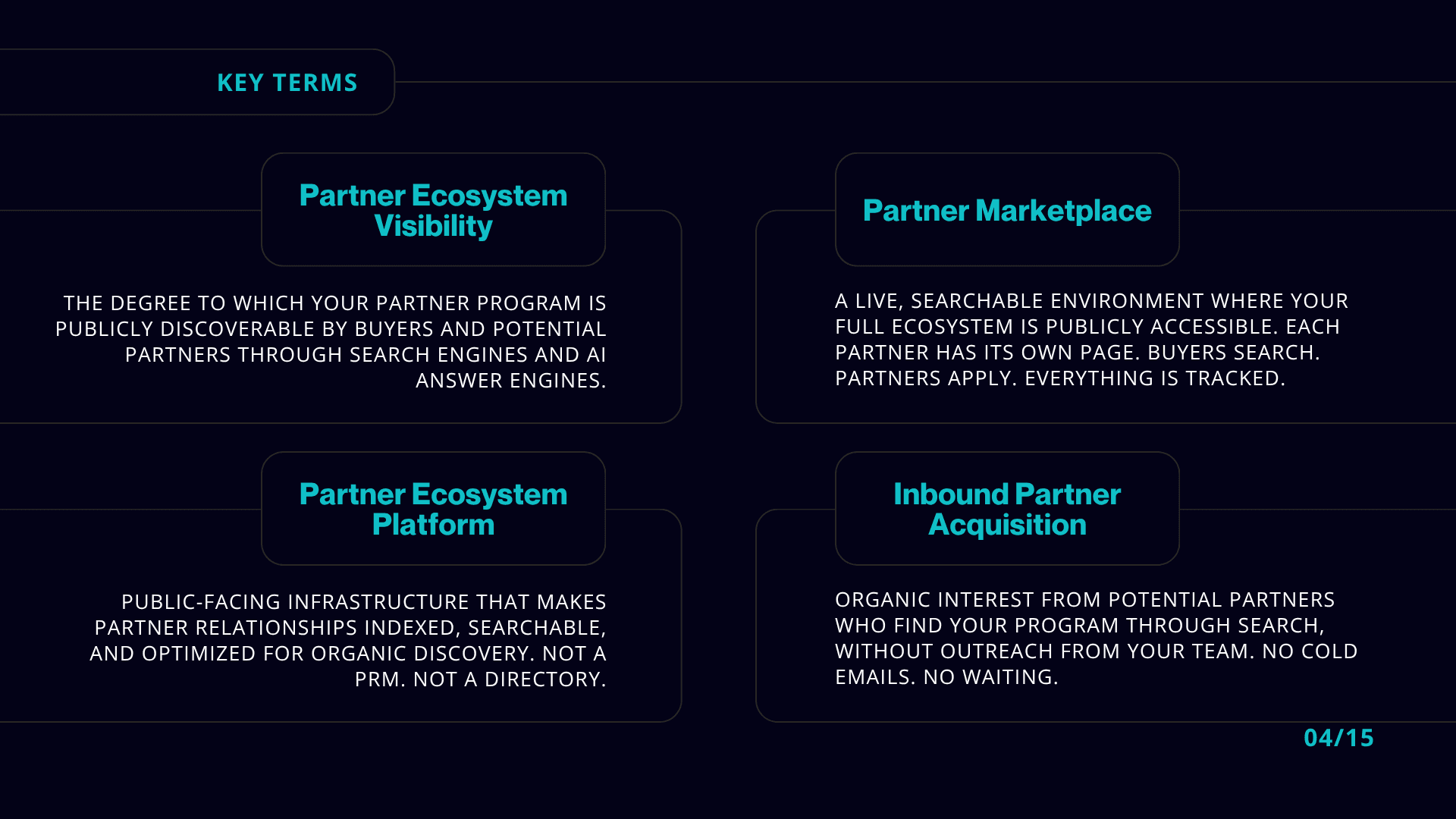
These four concepts are distinct. Conflating them is one of the main reasons partner programs stay invisible longer than they need to.
The Difference Between a Partner Directory and a Partner Ecosystem Platform
These two things are often treated as equivalent. They are not.
Partner Directory | Partner Ecosystem Platform | |
|---|---|---|
Indexed by search engines | Sometimes, inconsistently | Yes, by design |
Optimized for buyer discovery | No | Yes |
Each partner has its own page | No | Yes |
Inbound partner applications | No | Built in |
Lead capture from partner pages | No | Built in |
Performance tracking | None | Full analytics |
Updates automatically | Manual | AI-assisted |
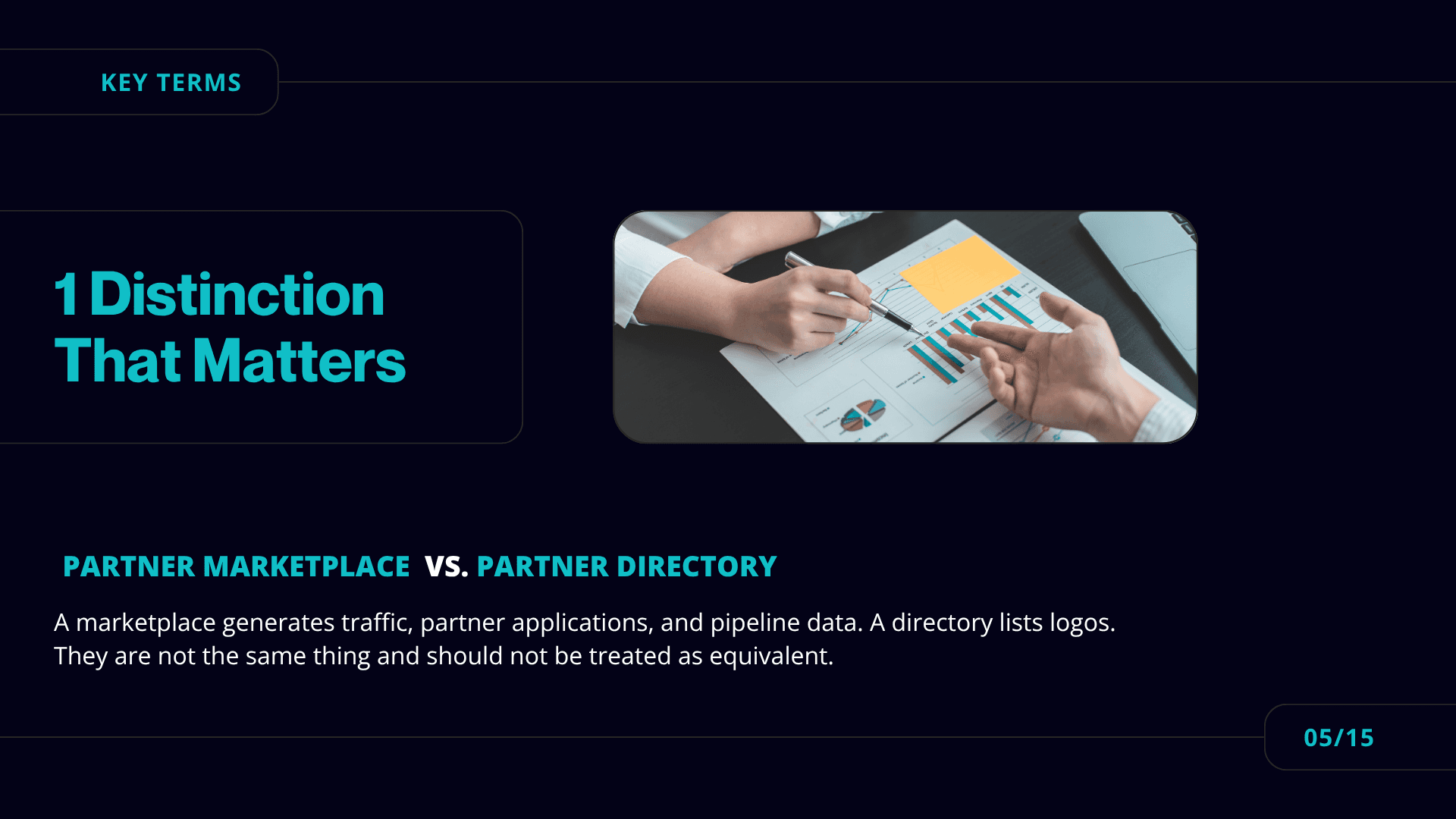
A directory is a list. An ecosystem platform is a channel. The distinction matters because a directory produces no organic activity on its own. An ecosystem platform generates traffic, partner applications, and buyer intent signals continuously, without anyone on your team initiating them.
Why Ecosystem Visibility Is an Inbound Partner Acquisition Channel
When a company with complementary technology searches for "[your product] integration partner" or "[your product] partner program," they are expressing intent. If your program is visible, they find you. If it isn't, they find a competitor whose program is.
This is the inbound partner acquisition mechanic. It works the same way inbound sales works for your product: someone has a problem or an interest, they search, and they find you because your content is indexed and ranked. The difference is that most companies optimize obsessively for buyer inbound and completely ignore partner inbound.
The infrastructure required is the same. Indexed pages. Clear value propositions. A way to apply or get in contact. Tracking on what's working.
When each partner in your ecosystem has its own optimized page, each page ranks independently for "[partner name] + [your product] integration" searches. A company with 50 integration partners has 50 pages generating organic traffic. That is not a linear gain. It compounds as you add partners, as partners link back to their listing, and as buyers discover your ecosystem through searches you never directly targeted.
For this inbound mechanic to work consistently, visibility cannot be partial. There are three layers that need to be in place, and removing any one of them breaks the channel.
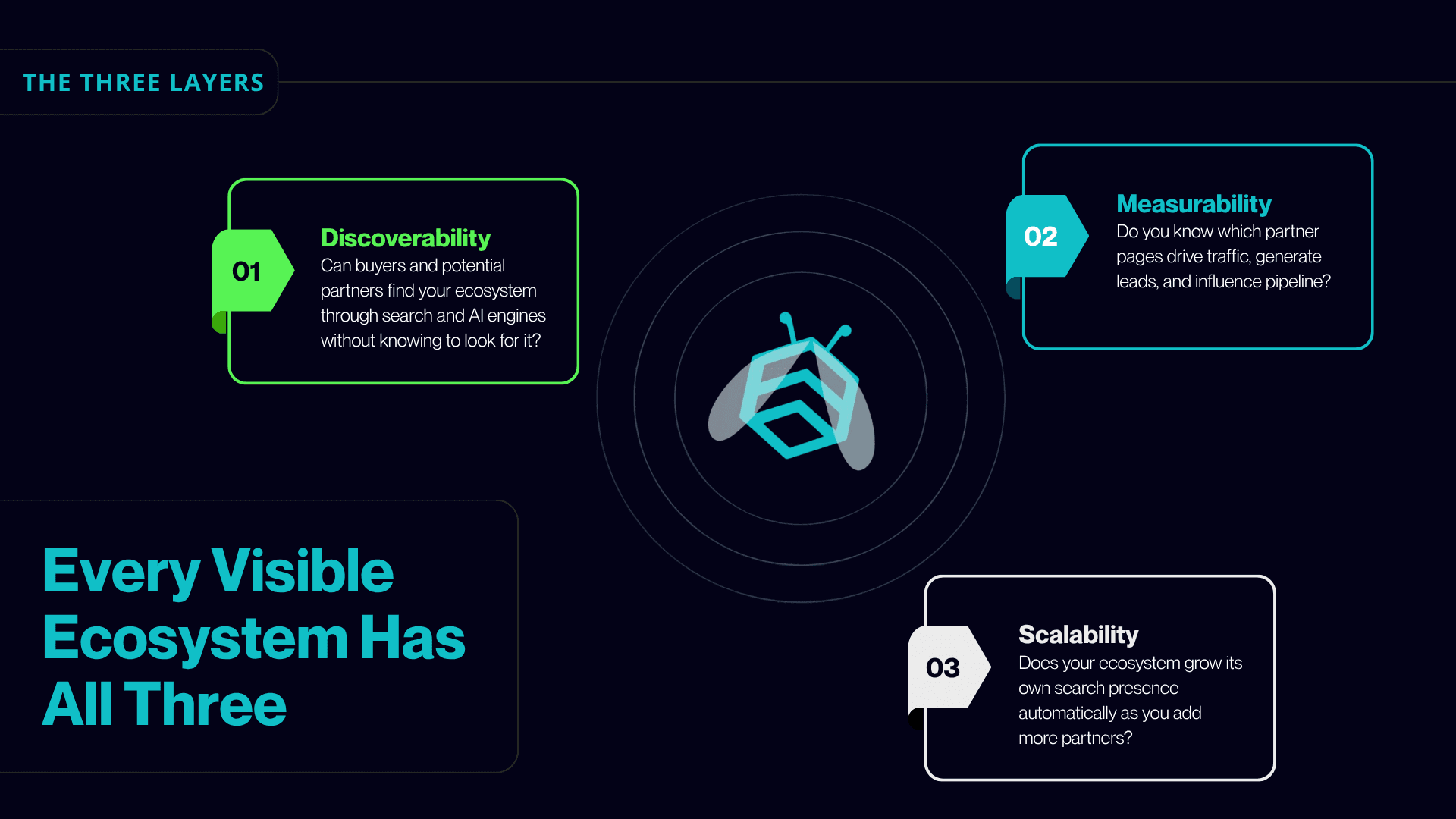
Discoverability is whether buyers and potential partners can find your ecosystem through search and AI engines without knowing to look for it. This is the entry point. Without it, nothing else matters.
Measurability is whether you know which partner pages drive traffic, generate leads, and influence pipeline. Without it, visibility produces activity you cannot attribute, defend to leadership, or improve over time.
Scalability is whether your ecosystem grows its own search presence automatically as you add more partners. Each new partner page adds search surface area, inbound link potential, and topical authority simultaneously.
When all three layers are in place, ecosystem visibility stops being a project and starts being a channel. That channel works for buyers too, not just for partner acquisitio
What Ecosystem Visibility Means for B2B Buyers
Partners are not the only audience for ecosystem visibility. Buyers use it too.
A B2B buyer evaluating your product will check what integrations you support. If that information is hard to find, incomplete, or buried in a static page with no detail, it creates friction. The buyer is looking for whether your product fits their existing stack. If they can't quickly verify that it does, they move on.
A visible partner ecosystem resolves this before sales is involved. The buyer finds your partner marketplace, searches for the tools they already use, confirms the integrations exist, and enters your pipeline already past the fit question. Sales cycles that start with a buyer who found your ecosystem through search tend to move faster, because the buyer has already done their own due diligence.
This is why your partner ecosystem is not a secondary asset. It is part of your product's value proposition, visible or not.
How to Build Ecosystem Visibility: Four Requirements
Building a visible partner ecosystem is an infrastructure decision, not a content decision. These are the four things that need to be in place.
1. Indexed, individually optimized partner pages
Each partner needs a public page that lives on your domain, is indexed by search engines, and contains enough structured content to rank for integration-related queries. A logo and a one-line description won't rank. A page with the integration use case, the combined value, supported features, and a CTA will.
2. SEO and AEO optimization at the page level
Every partner page needs a title tag, meta description, and on-page content structured around how buyers and potential partners actually search. It also needs to be structured for AI answer engines. If someone asks Perplexity "does [your product] integrate with [partner]," the answer should come from your page, not from a third-party review site.
3. Inbound partner application flow
Visibility without a conversion mechanism is incomplete. If a potential partner finds your ecosystem page and there is no clear way to apply, start a conversation, or understand what partnership looks like, the inbound interest dissipates. The application or inquiry form needs to be on the page, not behind a wall or buried in a footer.
4. Performance tracking tied to pipeline
A visible ecosystem that isn't measured stays invisible to your internal stakeholders. You need to know which partner pages drive the most traffic, where partner inquiries come from, and how ecosystem-sourced leads convert compared to other channels. Without that, the ecosystem remains a cost center in the eyes of your CFO, regardless of what it's actually doing.
The Compound Effect: Why Visibility Grows Over Time
One indexed partner page produces modest results. Twenty produce meaningful organic traffic. Fifty produce a channel that operates independently of your outbound efforts.
The compounding happens in three ways.
First, each new partner page adds a new search surface.
Second, when partners link to their listing on your marketplace from their own website and marketing, you get inbound links that strengthen the overall domain authority of your partner ecosystem.
Third, as your ecosystem grows in partner count and content depth, it starts to rank for broader category searches, not just partner-specific ones.
This is why companies that build ecosystem visibility early own it for a long time. The accumulation of indexed pages, backlinks, and topical authority is not something a competitor can replicate quickly.
Bonobee is built specifically to enable this. Each marketplace launched on the platform is structured from the start for SEO and AEO optimization, with partner pages that are designed to rank, capture leads, and track performance without ongoing manual effort from your team.
Platform Ecosystem vs. Partner Ecosystem: What's the Difference
These terms are used interchangeably in some contexts and mean distinct things in others.
A platform ecosystem refers to the broader network of developers, ISVs, and technology partners who build on top of a platform's infrastructure, typically through APIs or SDKs. Salesforce AppExchange and Shopify App Store are platform ecosystems.
A partner ecosystem refers to the organized set of relationships a company maintains with integration partners, resellers, referral partners, and strategic alliances. It includes the program structure, tiers, incentives, and enablement resources.
Visibility applies to both, but the mechanics are different. Platform ecosystems need app marketplace discoverability. Partner ecosystems need partner marketplace infrastructure. For most B2B SaaS companies that are not operating a developer platform, the relevant investment is partner ecosystem visibility, not platform ecosystem infrastructure.
FAQ
What is partner ecosystem visibility?
Partner ecosystem visibility is the extent to which a company's partner program is publicly discoverable through search engines, AI answer engines, and direct navigation. A visible partner ecosystem has indexed pages for each partner, appears in relevant search results, and enables buyers and potential partners to find and evaluate the program without outreach.
How does ecosystem visibility generate inbound partner acquisition?
When partner program pages are indexed and optimized for search, potential partners who are actively looking for integration or referral relationships find them through organic search. Each partner page on an optimized ecosystem platform ranks for queries like "[partner name] + [vendor] integration" or "[vendor] partner program," surfacing the program to relevant audiences without paid advertising or outbound effort.
What is the difference between a partner ecosystem platform and a PRM?
A partner relationship management tool (PRM) is an internal system for managing existing partner relationships, tracking deals, and storing documents. It is not public-facing. A partner ecosystem platform is public infrastructure that makes partner relationships visible and discoverable externally. The two serve different functions and are not substitutes for each other.
Why do most partner programs fail to generate inbound interest?
Most partner programs are built as internal operations with no public-facing infrastructure. There are no indexed partner pages, no searchable marketplace, and no application flow visible to potential partners. Without those, inbound partner interest is effectively zero regardless of how strong the program is internally. Visibility is an infrastructure problem, not a strategy problem.
What does AEO mean for partner ecosystem content?
AEO (Answer Engine Optimization) means structuring partner ecosystem content so that AI tools like ChatGPT, Perplexity, and Google AI Overviews can extract and cite it accurately. This requires direct definitions early in each page, FAQ sections with self-contained answers, and clear heading structures that match how buyers and partners phrase questions. An ecosystem that is SEO-optimized but not AEO-optimized will be invisible to an increasingly large share of the buyer research journey.
How many partner pages does it take to see organic traffic results?
There is no fixed number, but meaningful compounding typically begins around 15 to 20 indexed, well-optimized partner pages. Below that threshold, individual pages may rank for their specific queries but will not generate enough aggregate volume to show as a traffic channel. The more partners are listed, the stronger the effect, because each page adds search surface area and the domain builds topical authority in the partner ecosystem category.
Quick Reference
Partner ecosystem visibility: the degree to which your partner program is publicly discoverable by buyers and potential partners via search and AI engines
Partner ecosystem platform: infrastructure that makes partner relationships indexed, searchable, and optimized for organic discovery
Partner directory: a static list of partners, not indexed at the partner level, no inbound mechanics
Inbound partner acquisition: organic interest from potential partners who find your program through search, without outreach
AEO (Answer Engine Optimization): structuring content so AI tools can accurately extract and surface it in answer-based queries
The compound effect: each new optimized partner page adds search surface, backlink potential, and topical authority, compounding over time
Platform ecosystem vs. partner ecosystem: platform ecosystems involve developers building on your infrastructure; partner ecosystems involve integration, referral, and reseller relationships
See Your Partner Ecosystem Live
If your partner program is not generating inbound partner applications or showing up in searches for your integrations, it is an infrastructure problem. The program may be strong. The visibility just isn't there yet.
Bonobee builds the infrastructure that fixes that. A partner marketplace on your domain, with individual pages for every partner, SEO and AEO optimization built in, lead capture, and analytics that show you exactly what your ecosystem is producing.

Elena Zap
Co-founder & CEO

