
Stay tuned on LinkedIn to be the first to hear about our updates!
Quick Answer
Partner marketing infrastructure is the operational system that enables a B2B partner program to generate pipeline, prove attribution, and scale without proportional manual effort.
It spans the full GTM motion: how partners get discovered, how partner activity gets measured, how content scales, and how the program earns its place in the revenue conversation. A partner marketplace is one component of that infrastructure, not the whole of it.
Most B2B marketing teams have a partner strategy. Very few have the infrastructure to run it.
The strategy lives in a deck. The infrastructure is what makes it operational. And the gap between the two is where most partner programs stall: not because the partnerships are weak, but because the system underneath them was never built.
Partner marketing infrastructure is that system. This article explains what it is, what it includes, and why getting it right matters more than the strategy it supports.
Key Terms Before We Start
Partner marketing infrastructure is the connected set of systems, processes, and content layers that enables a partner program to operate as a GTM channel. It is not a tool, a campaign, or a marketplace. It is the operational foundation.
Ecosystem-led growth is the go-to-market motion where the partner ecosystem drives pipeline directly. Infrastructure is what makes ecosystem-led growth operational rather than aspirational.
Partner-sourced pipeline is revenue where a partner was the original source of the opportunity. Tracking it requires attribution infrastructure. Without that, it is invisible in the numbers regardless of how much it actually exists.
What Partner Marketing Infrastructure Actually Is
Partner marketing infrastructure is wider than most people think and narrower than most people build.
Wider, because it is not just about the partner-facing experience. It spans every function that touches the partner program: marketing creates the visibility layer, sales uses the ecosystem in deal conversations, product builds the integrations that populate it, CS guides customers to relevant partners, and partnerships owns the relationships that make all of it possible.
Narrower, because it is not about having more tools. Most companies already have a PRM, a CRM, a content management system, and some version of a partner page. What they are missing is the connective layer that makes those tools work together as a system rather than a collection of separate pieces.
Partner marketing infrastructure is that connective layer.
Why Most Partner Programs Do Not Have It
The gap is structural, not strategic.
Partner programs are almost always built by partnerships teams focused on managing relationships. The operational infrastructure that makes those relationships visible, measurable, and scalable gets treated as a secondary concern, something to build later once the program has more partners or more budget.
Later rarely comes. The result is a program that manages existing partners reasonably well but generates no organic activity from the outside, produces no measurable attribution for leadership, and cannot scale without adding headcount proportionally.
Three patterns show up consistently:
The visibility gap. Partner relationships exist but buyers cannot find them. There are no indexed pages, no searchable ecosystem, no integration content that ranks for the queries buyers are actually running. The program is invisible to the market it is supposed to serve.
The measurement gap. Partner activity is generating value but the team cannot prove it. Without attribution infrastructure, partner-influenced pipeline does not show up in the numbers. That makes the program hard to fund and harder to protect when budgets tighten.
The scale gap. The program works at 10 partners because everything is managed manually. At 50 partners, the same manual processes break. There is no content infrastructure that scales with partner count, no automated lead routing, no system that updates without someone doing the work by hand.
Infrastructure solves all three. But only if it is built with the right scope.
Read more: How to Build a Partner Marketing Strategy That Actually Drives Pipeline
The Six Components of Partner Marketing Infrastructure
Partner marketing infrastructure is not a single platform or tool. It is six connected layers. Each one is necessary. None of them works in isolation.
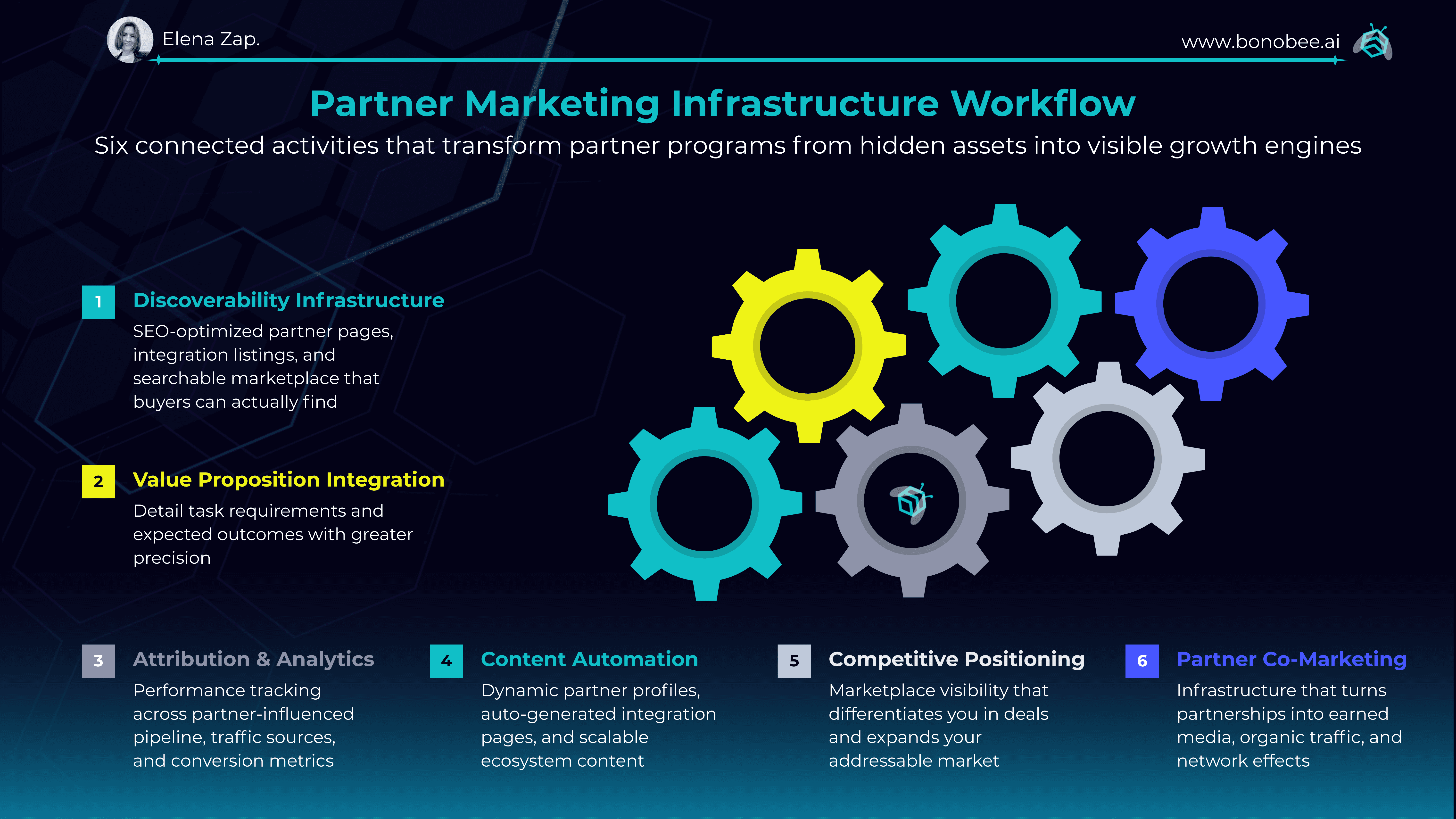
1. Discoverability Infrastructure
The system that makes your partner ecosystem findable by buyers and potential partners through search engines and AI answer engines. This includes SEO and AEO-optimized partner pages, integration listings, and a searchable partner marketplace. Discoverability is the entry point for all inbound activity. Without it, the other five layers have no traffic to work with.
The partner marketplace is the most visible expression of discoverability infrastructure. But discoverability also includes how your blog content references your ecosystem, how your product pages surface integrations, and whether your partner content is structured for AI answer engine extraction.
2. Value Proposition Integration
The infrastructure that ensures every partner relationship communicates a specific, buyer-relevant value proposition across every channel where it appears. This is not just about partner pages. It is about how the ecosystem shows up in product marketing, in sales decks, in customer success conversations, and in competitive positioning.
Your ecosystem is part of your value proposition. Value proposition integration is the infrastructure that makes that true operationally, not just in principle.
3. Attribution and Analytics
The measurement layer that connects partner activity to pipeline, revenue, and retention. This includes how partner-sourced leads are tagged in your CRM, how partner-influenced deals are identified and reported, and how traffic from partner pages connects to conversion events.
Without this layer, partner marketing is a cost center with no proof of output. With it, the program earns a measurable place in the revenue conversation.
4. Content Automation
The systems that enable partner-related content to scale without proportional manual effort. At 10 partners, content can be managed manually. At 50, it cannot. Content automation includes auto-generated partner profiles, templated integration pages, AI-assisted content updates, and processes that maintain content quality as the ecosystem grows.
Content automation is also what enables the compound effect. Each new partner added to the ecosystem generates a new indexed page, a new backlink surface, and a new search entry point. That only works if the content infrastructure can support it at scale.
5. Competitive Positioning
The infrastructure that makes your ecosystem visible and usable in active sales conversations. This includes how sales teams reference the marketplace in deals, how partner proof points get surfaced at the right stage of the buyer journey, and how ecosystem depth differentiates you from competitors who have the same core product capabilities.
Buyers who find your ecosystem before talking to sales enter the conversation already past the integration fit question. Competitive positioning infrastructure is what makes that happen consistently rather than occasionally.
6. Partner Co-Marketing
The systems and processes that enable partners to actively contribute to your marketing output without creating coordination overhead. When partners link to their listing on your marketplace, they generate backlinks. When they share their page with their audience, they drive traffic. When they co-create content, they extend your reach into adjacent audiences.
Co-marketing infrastructure makes this scalable. Partners should be able to access their listing, use co-marketing assets, and promote the relationship without requiring your team to manage every interaction manually.
Where the Partner Marketplace Fits
The partner marketplace is the discoverability layer of partner marketing infrastructure. It is the most visible component and often the highest-leverage starting point, but it is not the whole system.
A well-built partner marketplace makes your ecosystem searchable and indexed. It gives each partner their own optimized page. It captures inbound interest from buyers and potential partners. It provides the analytics that feed the measurement layer.
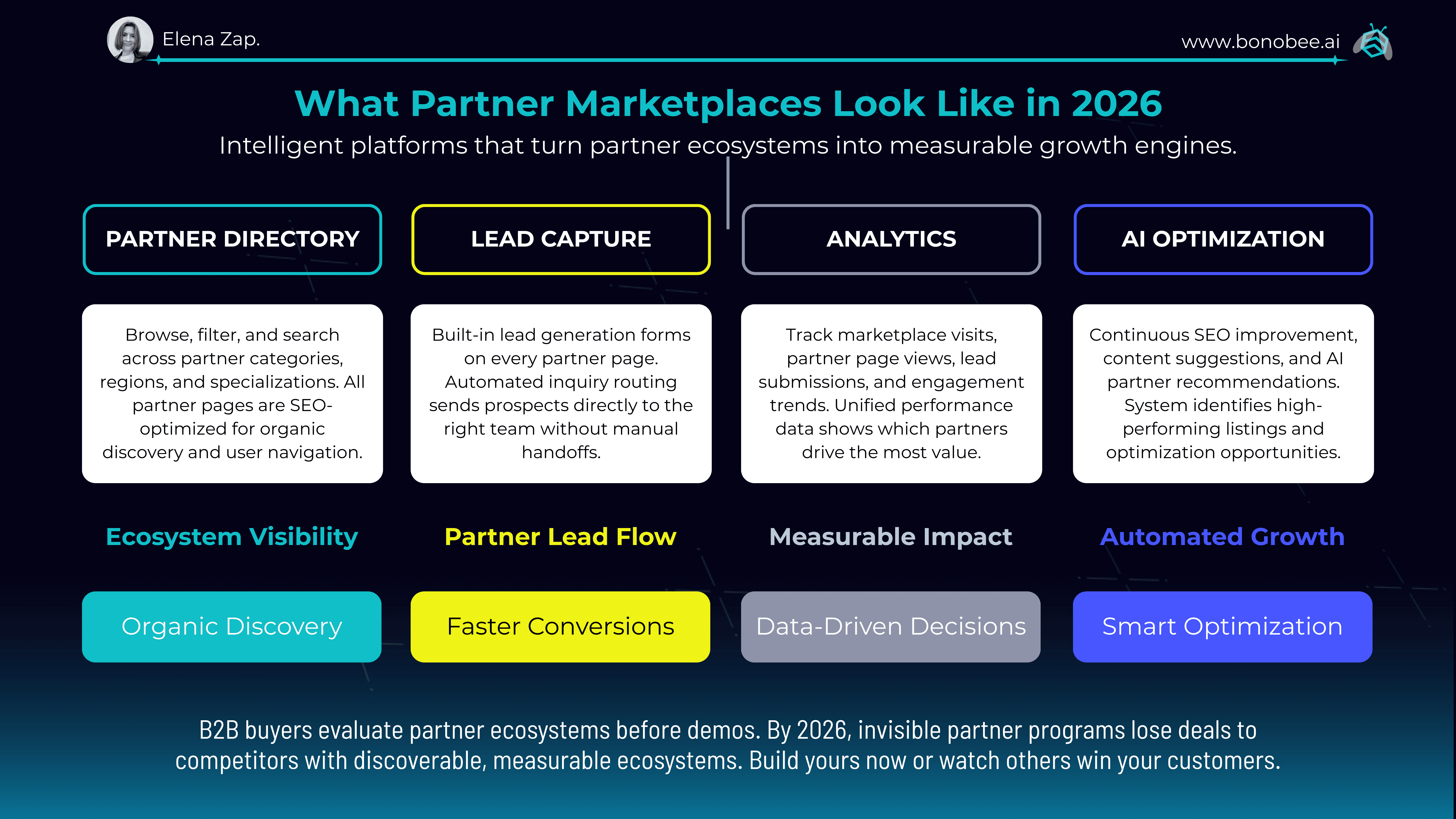
But the marketplace alone does not create attribution. It does not build the value proposition integration across your GTM motion. It does not enable co-marketing at scale or make your ecosystem usable in active sales conversations. Those require the other five layers to be in place.
The right way to think about the marketplace is as the foundation that the rest of the infrastructure builds on. Start there because it creates the surface area everything else depends on. But do not stop there.
How Partner Marketing Infrastructure Connects Across Your GTM Stack
One of the most important things to understand about partner marketing infrastructure is that it is not owned by one team. It is used by every function that touches the partner program.
Product Marketing uses the ecosystem as an organic traffic source and a conversion channel. Partner pages rank for integration searches. The marketplace becomes a proof point in competitive positioning.
Sales uses the marketplace as social proof and a deal accelerator. Showing a live, searchable ecosystem in a sales conversation is different from saying "we have 50 partners." One is a claim. The other is evidence.
Customer Success guides customers to relevant partners and integrations that expand platform value. The marketplace makes that guidance self-service rather than requiring CS to manage every referral manually.
Partnerships owns the relationships and ecosystem strategy while enabling cross-functional visibility into how the program is performing. Attribution infrastructure gives the partnerships team the data they need to have the revenue conversation with leadership.
Marketing creates and maintains the content infrastructure that makes all of it discoverable. Blog content references the ecosystem. Partner pages are optimized for search and AI. The marketplace is promoted as a destination, not just a resource.
When all five functions are connected through shared infrastructure, the partner program stops being a partnerships team project and starts being a GTM asset.
How to Build Partner Marketing Infrastructure: Where to Start
Building the full infrastructure does not happen in one sprint. These four steps create the foundation everything else builds on.
Step 1: Audit what exists Check whether your current partner pages are individually indexed, publicly accessible, and optimized for the searches your buyers are actually running. Check whether partner activity is tracked in your CRM. Check whether your team can answer the question: which partners influenced pipeline last quarter? The answers tell you where the gaps are.
Step 2: Build the discoverability layer first The partner marketplace creates the surface area everything else depends on. Without indexed pages, there is nothing for lead capture to convert, nothing for analytics to measure, and nothing for AI engines to extract and cite. Start public-facing.
Step 3: Add attribution before you scale Configure partner attribution in your CRM before the partner count grows. Knowing which partners drive traffic and pipeline from the start means every new partner added makes the data more useful rather than more complicated.
Step 4: Connect it across functions Partner marketing infrastructure works when every function that touches the partner program can access and use it. That means sales has a live marketplace to reference in deals. CS has an indexed directory to point customers to. Marketing has partner content feeding the blog and SEO strategy. Build the connections as you build the layers.
FAQ
What is partner marketing infrastructure?
Partner marketing infrastructure is the operational system that enables a B2B partner program to generate pipeline, prove attribution, and scale without proportional manual effort. It spans discoverability, value proposition integration, attribution and analytics, content automation, competitive positioning, and partner co-marketing.
Is a partner marketplace the same as partner marketing infrastructure?
No. A partner marketplace is the discoverability layer of partner marketing infrastructure. It makes your ecosystem publicly visible and searchable. The full infrastructure also includes attribution tracking, content automation, value proposition integration across the GTM stack, competitive positioning, and co-marketing systems. The marketplace is the starting point, not the complete system.
Why do most B2B partner programs lack infrastructure?
Most partner programs are built by partnerships teams focused on managing relationships rather than marketing teams focused on systems. The operational infrastructure that makes those relationships visible, measurable, and scalable gets deferred until the program is larger. The result is a program that cannot prove its value or scale without adding headcount.
How does partner marketing infrastructure connect to ecosystem-led growth?
Ecosystem-led growth is the go-to-market motion where the partner ecosystem drives pipeline directly. Partner marketing infrastructure is what makes that motion operational. Without discoverability, attribution, and content automation in place, ecosystem-led growth remains a strategy without execution capability.
Which team owns partner marketing infrastructure?
No single team owns the full infrastructure. Partnerships owns the relationships and strategy. Marketing owns the discoverability and content layers. Sales uses the ecosystem in deal conversations. CS guides customers through the partner directory. Revenue ops owns attribution. The infrastructure works when all five functions are connected through shared systems.
What is the first step to building partner marketing infrastructure?
Audit what currently exists. Check whether partner pages are individually indexed and optimized. Check whether partner activity is tracked in your CRM. Check whether you can answer basic attribution questions about which partners influenced pipeline. The audit tells you where to start building.
Quick Reference
Partner marketing infrastructure: the operational system that makes a partner program discoverable, measurable, and scalable across the full GTM motion
Six components: discoverability, value proposition integration, attribution and analytics, content automation, competitive positioning, partner co-marketing
Partner marketplace: the discoverability layer of the infrastructure, not the full system
GTM functions involved: product marketing, sales, customer success, partnerships, marketing
Key distinction: infrastructure is wider than a marketplace and narrower than a tool stack
Right build order: discoverability first, attribution second, cross-functional connection third
See Your Partner Marketing Infrastructure in Action
If your partner program is generating value that leadership cannot see, partnerships that buyers cannot find, and co-marketing that requires constant manual coordination, the infrastructure is missing.
Bonobee builds the discoverability layer that everything else in your partner marketing infrastructure builds on. A partner marketplace on your domain, with individual optimized pages for every partner, SEO and AEO built in from day one, lead capture and analytics included.
See what it looks like with your actual partners: bonobee.ai

Elena Zap
Co-founder & CEO

