
Stay tuned on LinkedIn to be the first to hear about our updates!
A partner marketing strategy is a plan for how a company promotes its partner ecosystem, acquires new partners, and generates revenue through partner-influenced channels. It covers how you attract partners, how you enable them to market on your behalf, and how you make your ecosystem visible to the buyers who need to find it.
The key word is strategy. Most companies have partner marketing activity. They run a webinar with a partner, share a joint press release, maybe send an email to their list. None of that is a strategy. A strategy has defined goals, a clear infrastructure, measurable outcomes, and a system for scaling what works.
The Four Layers: One System
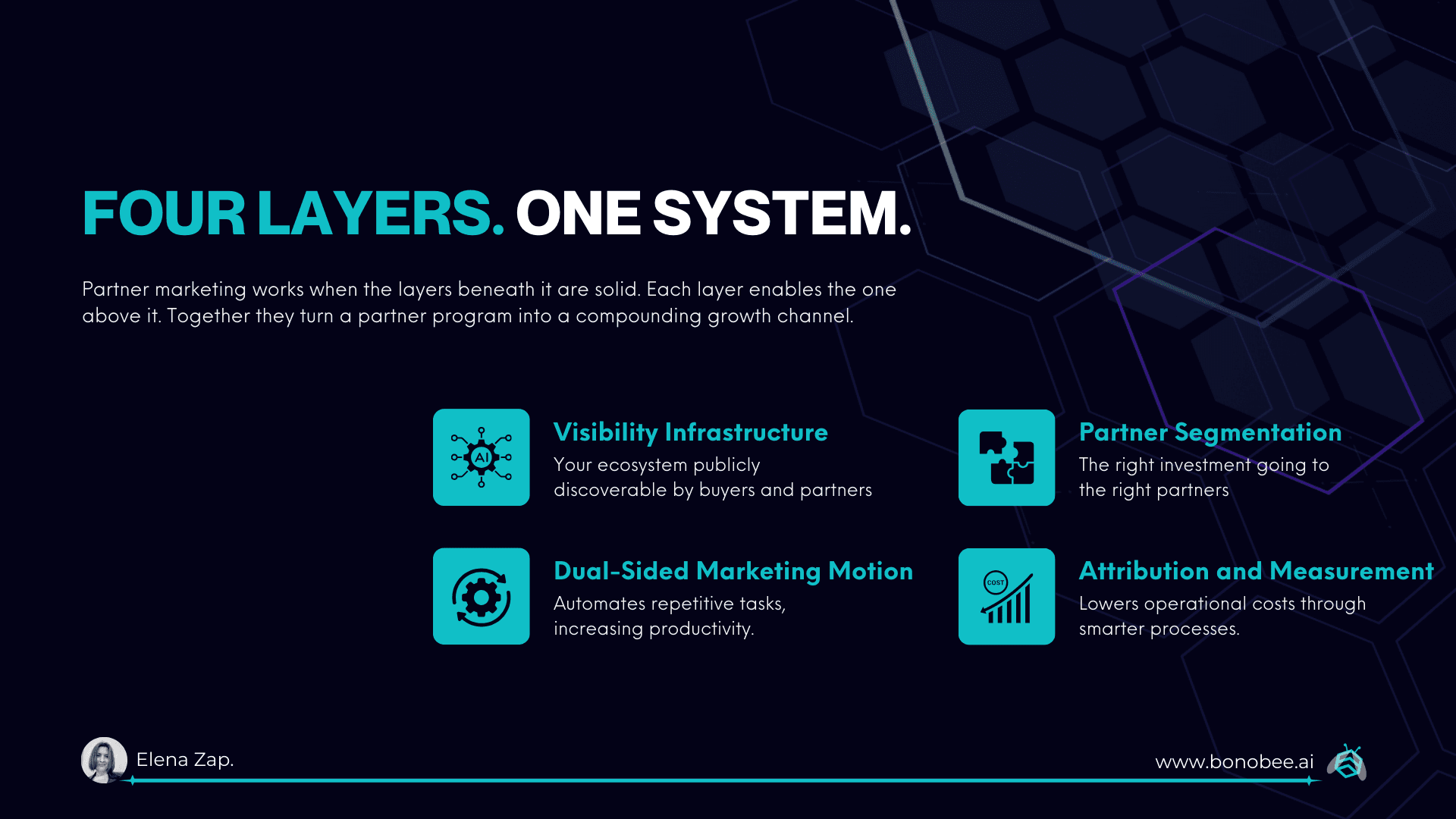
Partner marketing works when the layers beneath it are solid. Each layer enables the one above it. Together they turn a partner program into a compounding growth channel. The rest of this article walks through each layer in detail and what building it actually requires.
Layer 1: Visibility Infrastructure
Before you plan any campaign, your partner ecosystem needs to be publicly discoverable. This means a searchable partner marketplace on your domain, with individual indexed pages for each partner. Not a logo grid. Not a PDF. Pages that rank in search, that buyers land on during their research phase, and that potential partners find when they're evaluating programs to join.
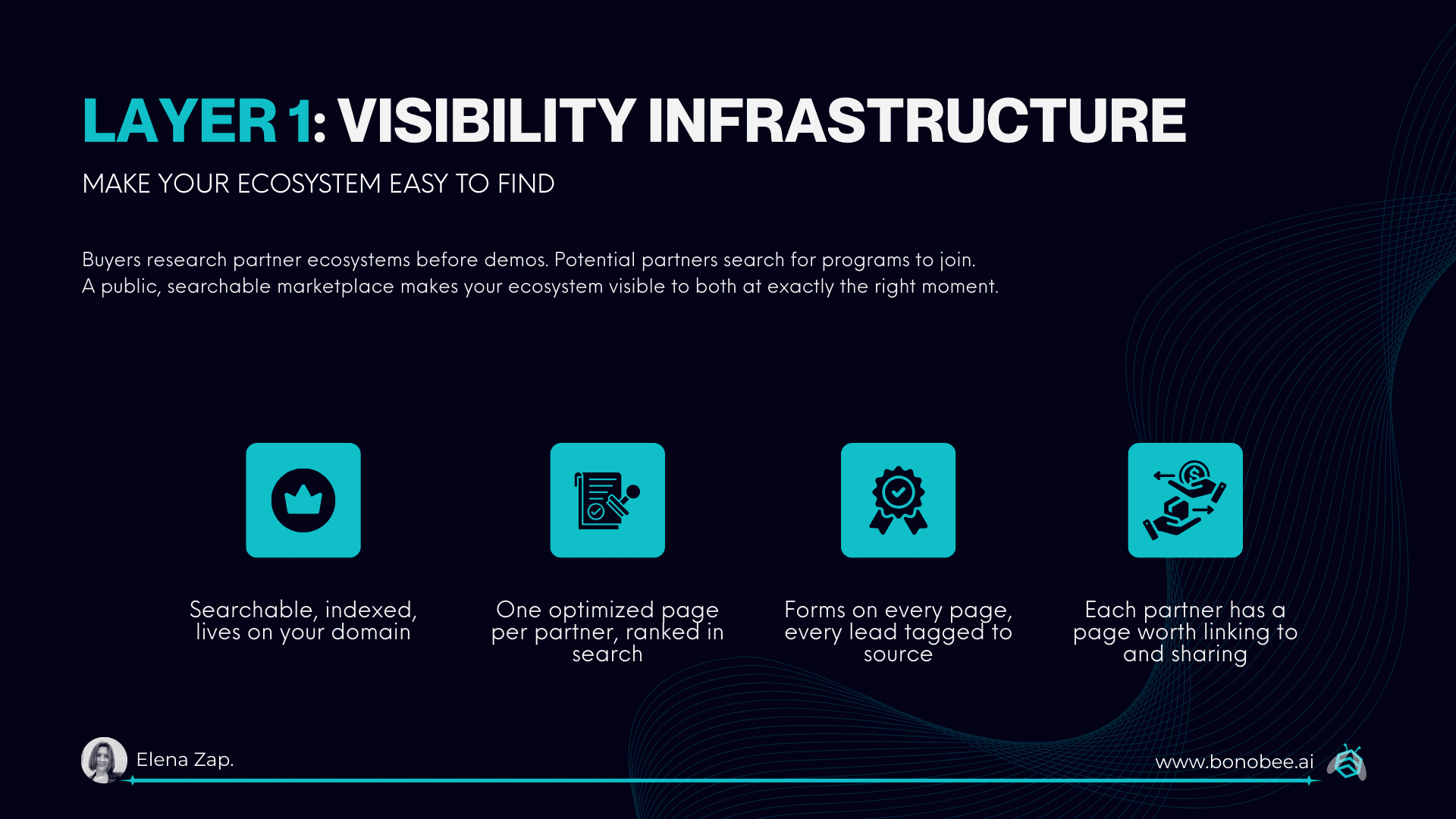
Co-marketing campaigns drive traffic somewhere. That somewhere needs to exist, convert, and track.
Each partner having their own page also changes the co-marketing dynamic entirely. Partners have something worth promoting. They link to it, share it, drive traffic to it. Every partner becomes a distribution channel, not just a relationship.
Layer 2: Partner Segmentation and ICP Matching
Not all partners deserve equal marketing investment. Your strategy needs a clear segmentation framework: what types of partners you have (technology, agency, channel, referral, strategic), which segments align most closely with your ICP, and which partners within each segment have the highest activation potential.
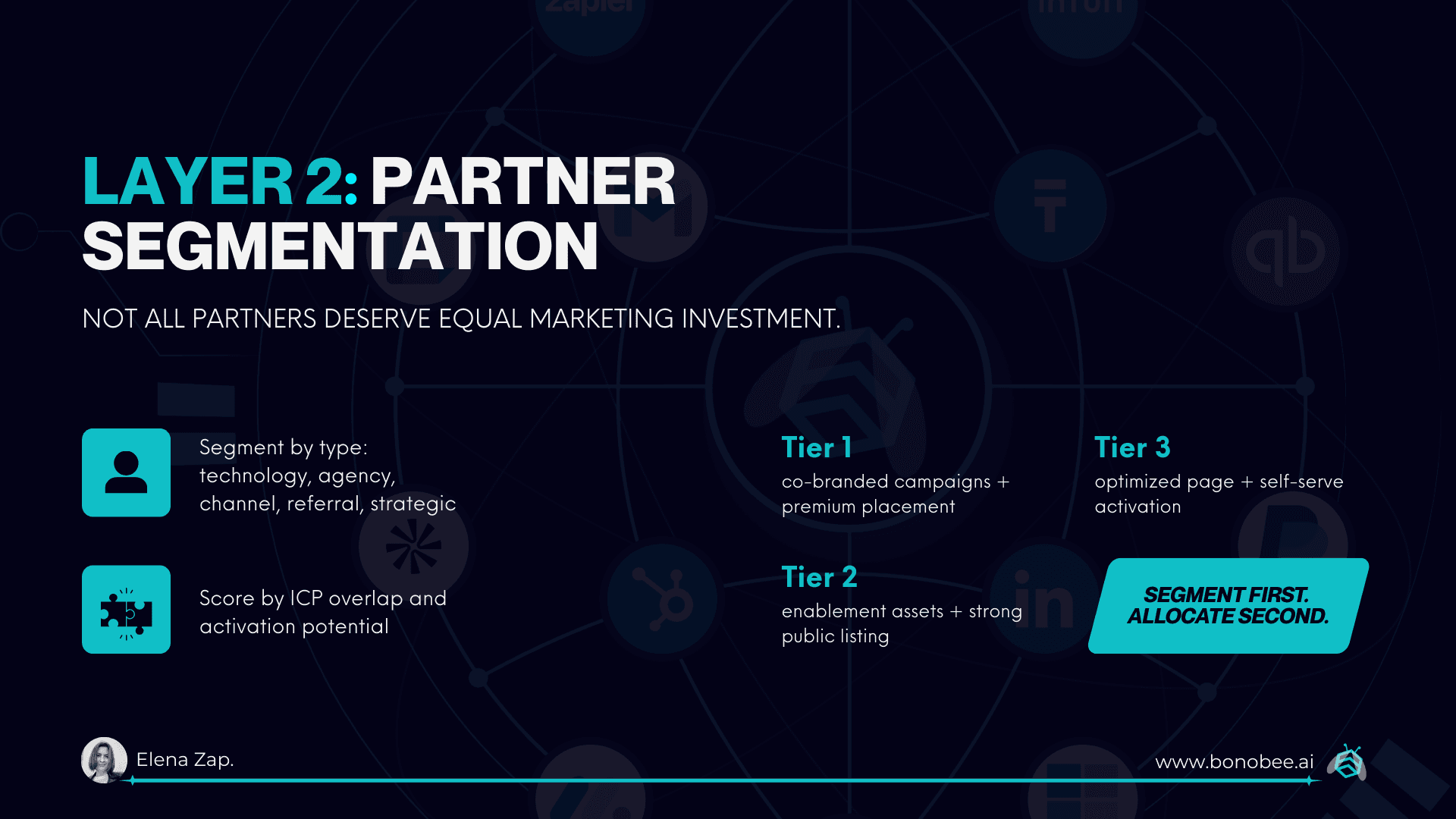
Segment first. Then allocate marketing resources accordingly.
Tier 1 partners get co-branded campaigns, joint content, and dedicated marketplace real estate
Tier 2 get enablement assets and a strong public listing
Tier 3 get a well-optimized page and clear self-serve activation paths
Treating every partner the same is how programs spread investment too thin and see nothing compound.
Layer 3: Dual-Sided Marketing Motion
Partner marketing runs in two directions simultaneously, and most companies only think about one.
Outward: marketing your ecosystem to buyers. Making it easy for prospects to discover your partners, understand what each integration or relationship delivers, and find the right fit during their evaluation. This is SEO and AEO-driven, content-led, and visibility-dependent.
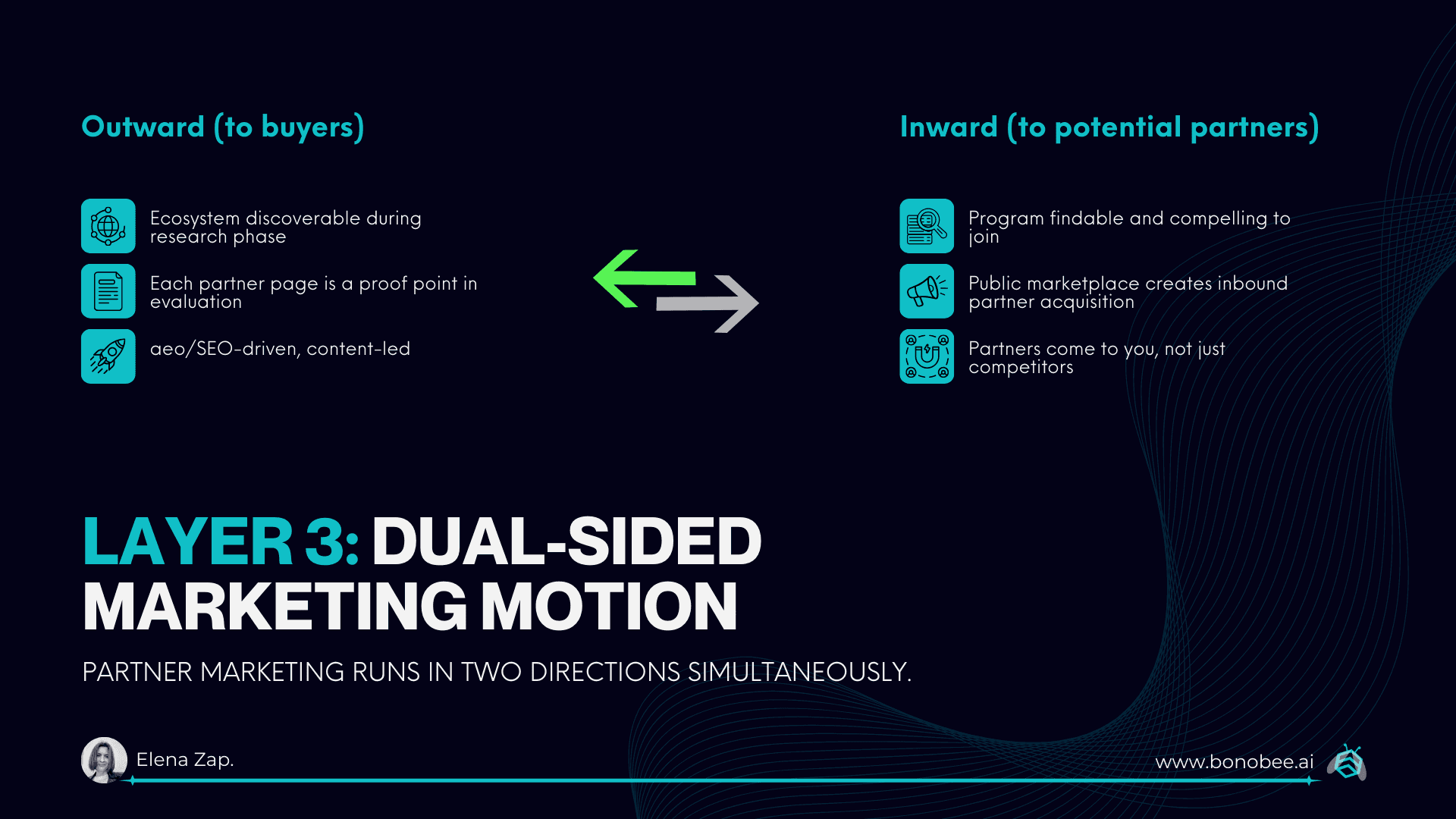
Inward: marketing your program to potential partners. Making it compelling and easy to find your partner program, understand what you offer, and apply. A public partner marketplace becomes an inbound acquisition channel for partners themselves, not just buyers.
Both directions need intentional goals, dedicated content, and separate measurement. A program that only markets outward to buyers misses half its growth surface.
Layer 4: Attribution and Measurement
A partner marketing strategy without attribution is guesswork with a budget. Every partner page needs to capture leads and tag them to source. Pipeline influenced by partners needs to be tracked separately from direct pipeline. Partner-sourced revenue needs its own line in reporting.
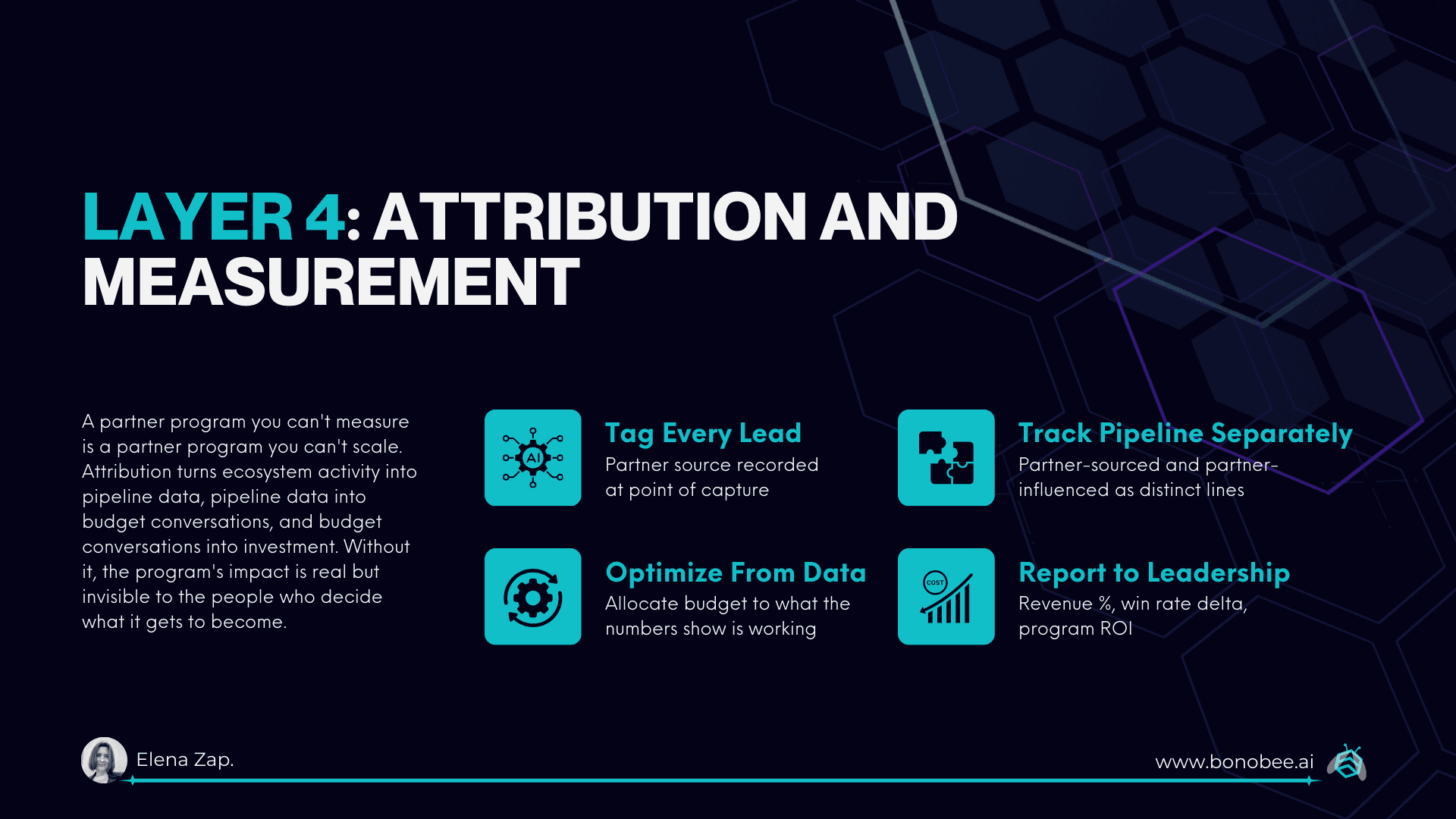
Three numbers that matter to leadership:
Partner-influenced revenue as a percentage of total revenue. Partner-influenced win rate compared to non-partner deals. Partner program ROI as a revenue-to-cost ratio.
Everything else is context for those three. Build your reporting so they're always current and defensible.
Building Your Partner Marketing Plan: Five Steps
Step 1: Audit your current ecosystem visibility.
Document where your partners live on your website today. Count how many clicks it takes for a buyer to find your ecosystem. Check whether your partner pages are indexed. If they're not, you have a list, not a foundation.
Step 2: Define goals tied to pipeline, not activity.
Activity metrics (webinars run, emails sent, content published) are outputs. Pipeline and revenue metrics are outcomes. Examples: generate X% of total pipeline through partner-influenced channels within 12 months. Grow inbound partner applications by X% through organic discovery.
Step 3: Build or migrate to a public partner marketplace.
Every partner gets an individual, AEO and SEO-optimized page. The marketplace is searchable and filterable by partner type, use case, industry, and region. Lead capture forms on every page, CRM integration live, every lead tagged to its partner source.
Step 4: Build your content calendar for both audiences.
For buyers: integration guides, use case pages, comparison content, customer stories involving partners. For potential partners: program pages, tier benefit breakdowns, application CTAs, success stories from existing partners. Distribute through your channels and through co-marketing with partners. Content performs best when both parties have skin in distribution.
Step 5: Set up attribution before launching campaigns.
Every partner page firing lead events into your CRM. Partner-influenced pipeline as a distinct field in deal records. Ecosystem traffic segmented in analytics. Run the operational dashboard monthly, the executive dashboard quarterly.
What a Strong Partner Marketing Strategy Looks Like in Practice
Atlassian, HubSpot, Klaviyo, Cloudflare. They treat their partner ecosystem like a product. Dedicated URL. Maintained and updated. Marketed actively. New partners announced. Integration depth highlighted in sales conversations.
HubSpot's partner ecosystem accounts for 45% of revenue and 33% of customer referrals. That doesn't happen through a static page and occasional co-marketing. It happens because the ecosystem is built into the company's GTM at every layer.
Quick Reference
What the strategy requires before campaigns can work: Public indexed partner marketplace, individual partner pages with SEO and AEO metadata and lead capture, CRM attribution tracking, clear partner segmentation and tier framework.
What the content calendar must cover: Buyer-facing: integration guides, use cases, partner comparison content. Partner-facing: program benefits, tier breakdowns, application CTAs, success stories.
How to measure success: Partner-influenced pipeline as % of total pipeline (target: 20-35%), organic traffic to ecosystem pages (target: 20-30% of total site traffic), inbound partner applications from organic discovery, partner-sourced revenue as a distinct revenue line.
Frequently Asked Questions
What is a partner marketing strategy? A partner marketing strategy is a plan for making a company's partner ecosystem visible to buyers and potential partners, enabling joint marketing activities, and measuring the revenue impact of partner-influenced pipeline. It combines visibility infrastructure, content, attribution, and co-marketing into a coordinated system.
How is partner marketing different from channel marketing? Channel marketing typically focuses on enabling resellers and distributors to sell your product. Partner marketing is broader: it covers all partner types and focuses on making the ecosystem discoverable and measurable, not just activating individual sales motions.
What should a partner marketing plan include? Ecosystem visibility infrastructure, partner segmentation, dual-sided marketing goals for buyers and potential partners, a content calendar covering both audiences, co-marketing activities by partner tier, and an attribution framework for measuring pipeline impact.
How do you measure partner marketing ROI? Partner-influenced revenue as a percentage of total revenue, partner-sourced pipeline, partner CAC compared to direct CAC, organic traffic to ecosystem pages, and inbound partner applications. All require attribution infrastructure to measure accurately.
What types of partners does a partner marketing strategy cover? Technology partners, agency partners, channel partners (resellers, distributors, MSPs), referral partners, and strategic partners. Each type requires different enablement, different co-marketing approaches, and different visibility infrastructure.
Partner Marketing Is a System, Not a Calendar
Partner marketing strategy isn't a content calendar or a co-marketing event schedule. It's a system. Four layers working together: visibility at the foundation, segmentation as the structure, dual-sided motion as the engine, and attribution as the proof.
Bonobee builds the partner marketplace infrastructure that makes partner marketing strategies work. See your partner marketplace live — book a demo.A partner marketing strategy is a plan for how a company promotes its partner ecosystem, acquires new partners, and generates revenue through partner-influenced channels. It covers how you attract partners, how you enable them to market on your behalf, and how you make your ecosystem visible to the buyers who need to find it.
The key word is strategy. Most companies have partner marketing activity. They run a webinar with a partner, share a joint press release, maybe send an email to their list. None of that is a strategy. A strategy has defined goals, a clear infrastructure, measurable outcomes, and a system for scaling what works.

Elena Zap
Co-founder & CEO

