
Stay tuned on LinkedIn to be the first to hear about our updates!
Quick Answer
An ecosystem moat is a competitive advantage built through visible partner relationships, integrations, and co-marketing that makes your product difficult to displace. It works during the 221 days a B2B buyer researches independently before talking to sales. In 2026, the ecosystem around your product is often more defensible than the product itself.
What Is an Ecosystem Moat
An ecosystem moat is not a partner program. It is not a list of signed agreements or a partner page that no one visits.
It is the cumulative competitive advantage that forms when your product is consistently visible across the networks, tools, and recommendations of the partners already trusted by your buyers.
The distinction matters because having partners and having an ecosystem moat are two different things. Most B2B tech companies have the former and believe they have the latter.
![What is an Ecosystem Moat — a competitive advantage built through visible partner relationships, integrations, and co-marketing that makes your product difficult to displace]](https://framerusercontent.com/images/hdYI7vWO67Fzdz10X0g1JoVlTg.png)
The moat works during the research phase, before a buyer ever contacts your sales team. According to Forrester, the average B2B buying journey involves 27 interactions before a purchase decision. A large portion of that journey happens independently, without vendor involvement. If your product is not visible in the places buyers look during that window, you are not on the shortlist.
Why the Ecosystem Around Your Product Is Often More Defensible Than the Product Itself
Product features can be copied. Pricing can be matched. AI is accelerating both. What a competitor cannot easily replicate is the network of co-marketing relationships, integration visibility, and partner-enabled trust signals you have built over 12 to 24 months.
This is the core argument behind the ecosystem moat: distribution compounds in ways that product does not.
A company with 40 active partners co-marketing and recommending them occupies a structural position in their category. A company with the same product and zero ecosystem visibility competes on feature sheets and cold outreach. These are not equivalent competitive positions, regardless of how similar the products are.
The Risks of Not Having an Ecosystem Moat
Most mid-market B2B companies understand that ecosystems matter. They still do not build the moat. The consequences are concrete.
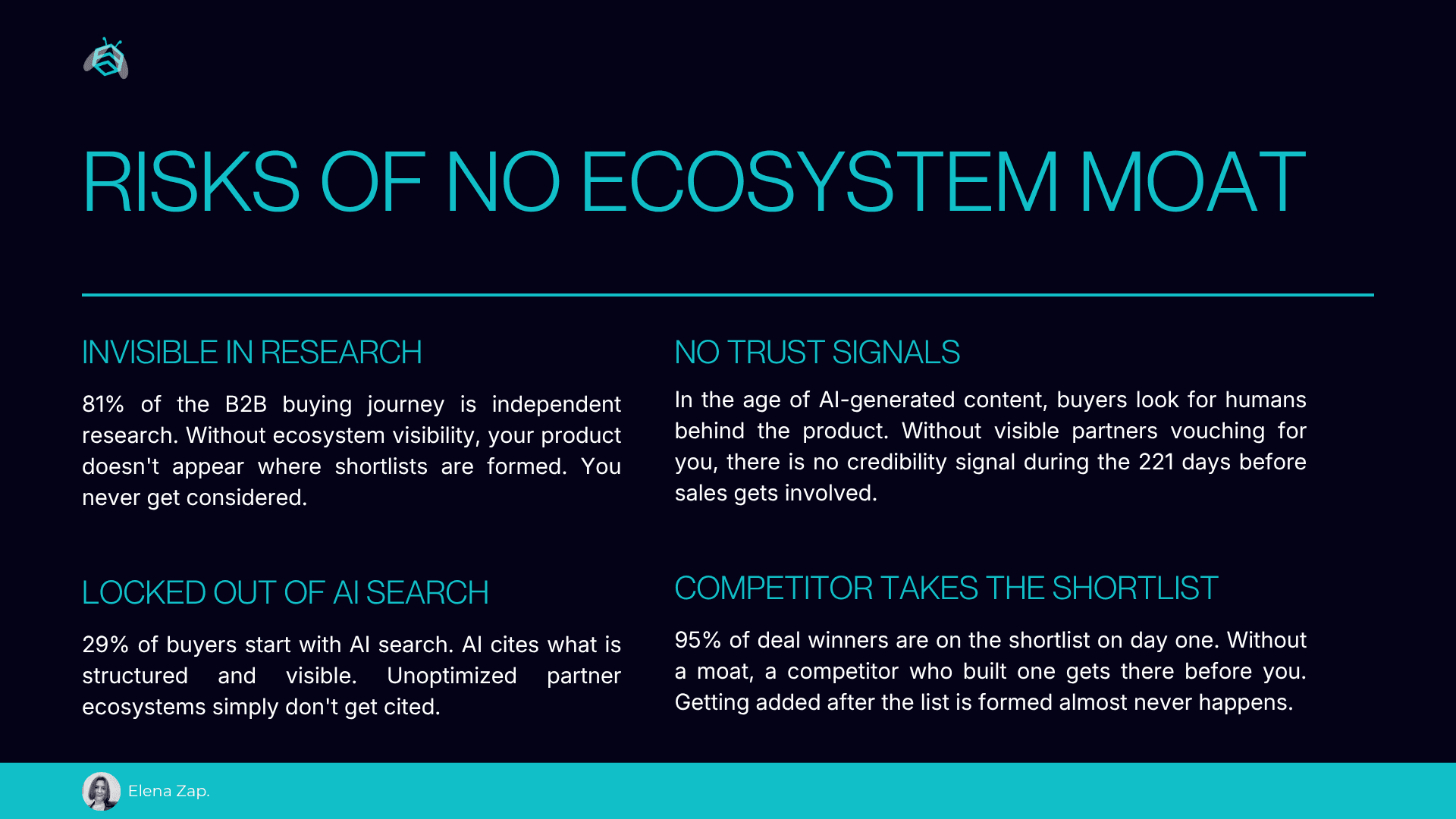
Invisible in research. According to Forrester, 81% of the B2B buying journey is independent research. Without ecosystem visibility, your product does not appear where shortlists are formed. You never get considered.
Locked out of AI search. Research from Gartner indicates that a growing share of B2B buyers now start product research with AI assistants. AI cites what is structured and visible. Unoptimized partner ecosystems are not cited. This is no longer a future risk. It is happening now.
No trust signals. In an environment saturated with AI-generated content, buyers look for humans and recognizable brands behind the product. Visible partners vouching for you provide credibility during the research phase that no amount of self-published content can replicate.
A competitor takes the shortlist. According to Gartner, 95% of deal winners are already on the buyer's shortlist on day one of the formal evaluation process. If a competitor built their moat before you, they are on that list and you are starting from behind.
What an Ecosystem Moat Is Not
This is where most companies get stuck. They look at what they have and believe it counts.
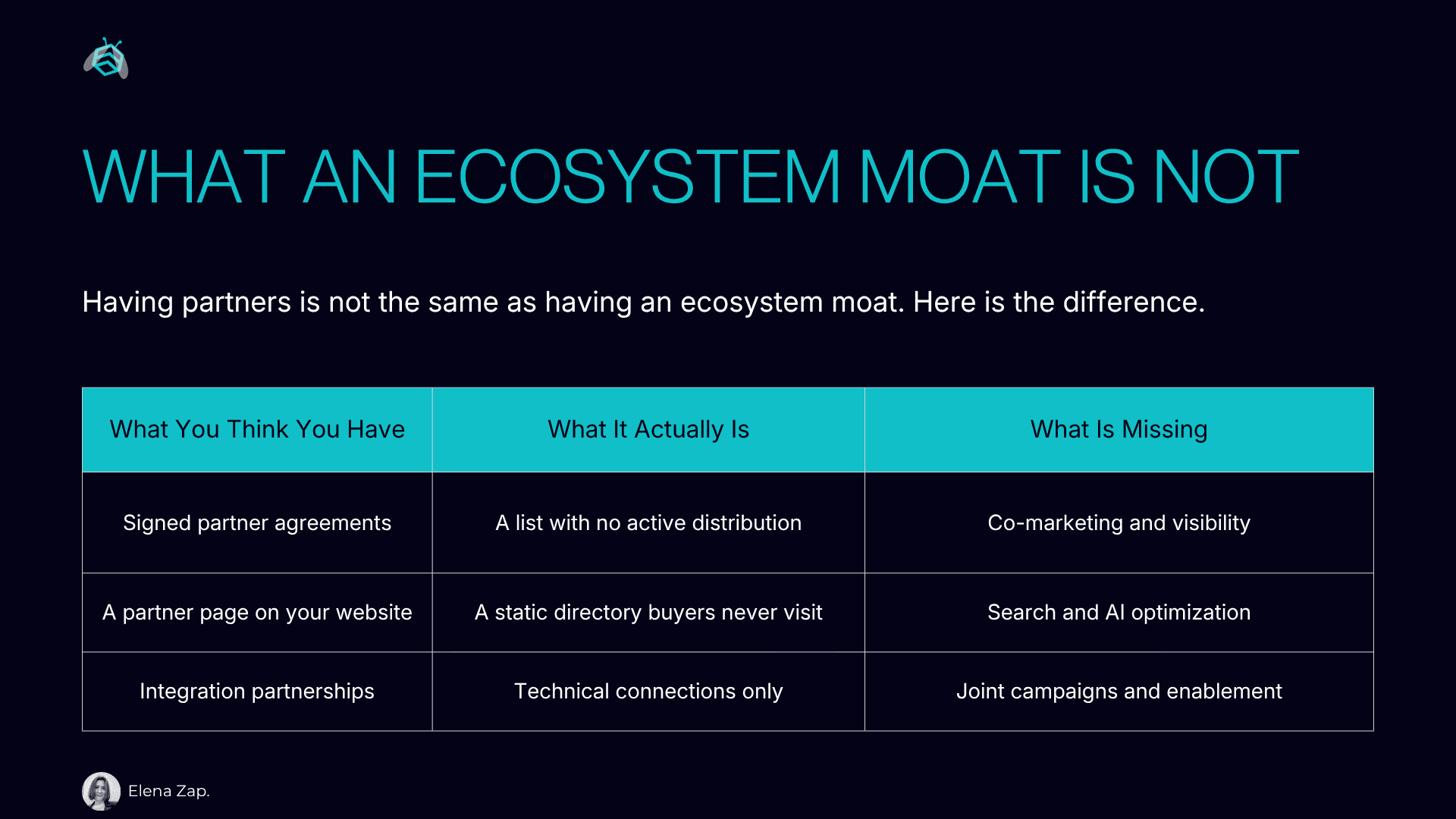
What You Think You Have | What It Actually Is | What Is Missing |
|---|---|---|
Signed partner agreements | A list with no active distribution | Co-marketing and visibility |
A partner page on your website | A static directory buyers never visit | Search and AI optimization |
Integration partnerships | Technical connections only | Joint campaigns and enablement |
The pattern is consistent. Companies confuse activity with infrastructure. Signed agreements feel like progress. A partner page feels like presence. Technical integrations feel like ecosystem. None of these create the compounding visibility that constitutes a moat.
Why Mid-Market Companies Ignore It
Understanding ecosystems matter and actually building the moat are separated by three specific barriers.
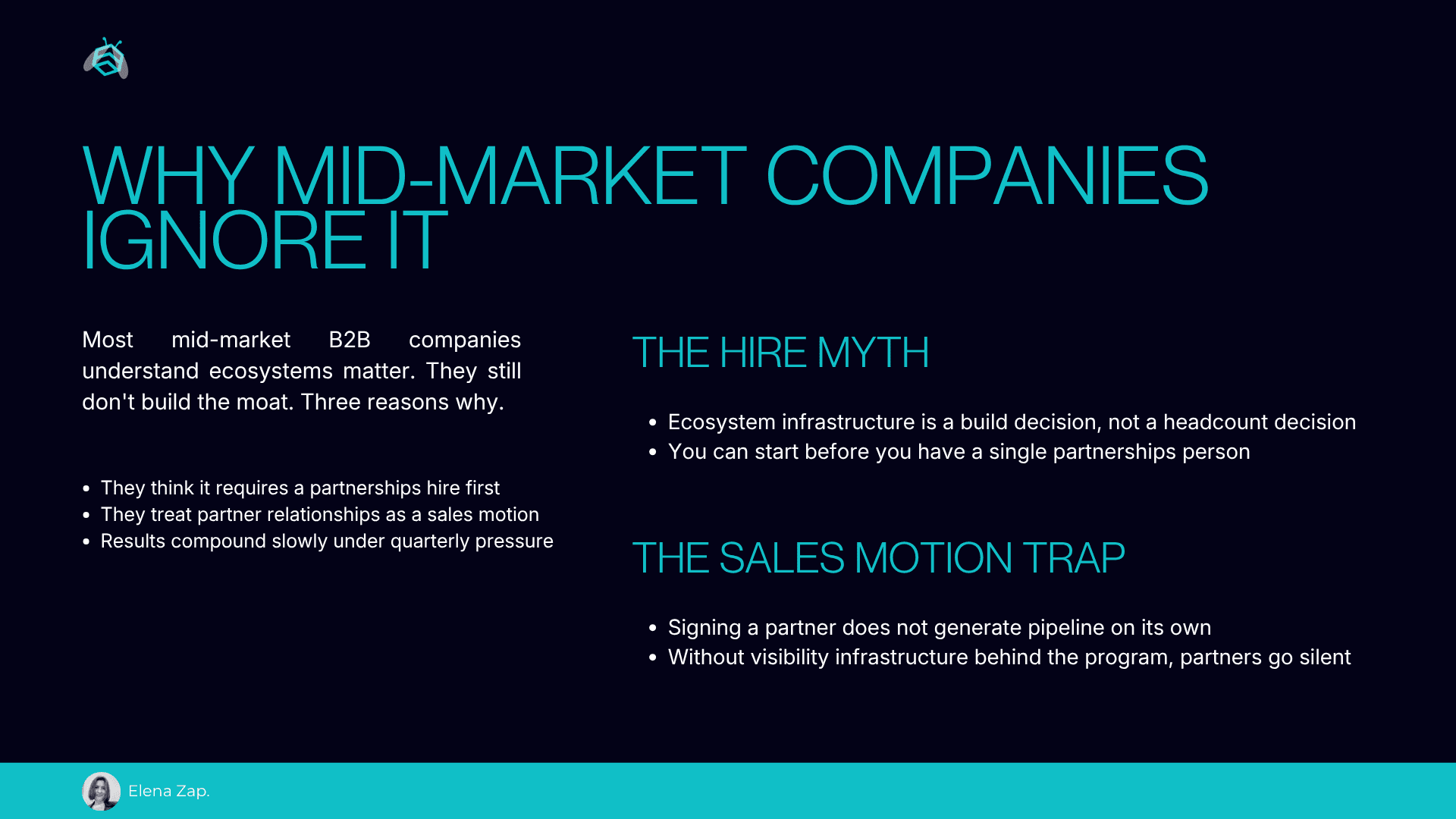
The hire myth.
The default assumption is that ecosystem infrastructure requires hiring a partnerships person first. It does not. Ecosystem infrastructure is a build decision, not a headcount decision. You can start before you have a single partnerships hire.
The sales motion trap.
Many companies treat partner relationships as a sales motion: sign the partner, expect pipeline. Signing a partner does not generate pipeline on its own. Without visibility infrastructure behind the program, partners go silent. The relationship stalls and the effort is written off as a failure of the concept rather than a failure of execution.
Quarterly pressure.
Ecosystem results compound slowly relative to quarterly sales targets. Leadership under short-term pressure deprioritizes investments with 6 to 12 month return cycles. This is rational at the individual quarter level and damaging at the company level over time.
What an Ecosystem Moat Looks Like in Practice
A visible ecosystem moat generates pipeline before your sales team makes a single call.
![What It Looks Like in Practice — inbound partner leads, shorter sales cycles, compounding distribution]](https://framerusercontent.com/images/mYaiqwjSuwx5Jqsx5WUrKXGbWs.png)
Inbound partner leads. Partners actively refer and co-sell your product. Qualified leads arrive without outbound effort from your team. The partner does the first qualification.
Shorter sales cycles. Buyers already know and trust you before the first call. Your ecosystem built that credibility during their independent research. Sales enters a warmed conversation, not a cold one.
Compounding distribution. Every new partner expands your reach into new audiences. The channel grows without growing your headcount or ad spend. This is the compounding dynamic that makes ecosystem moats structurally different from other GTM investments.
What Happens When a Competitor Builds It First
This is the scenario that matters most to understand.
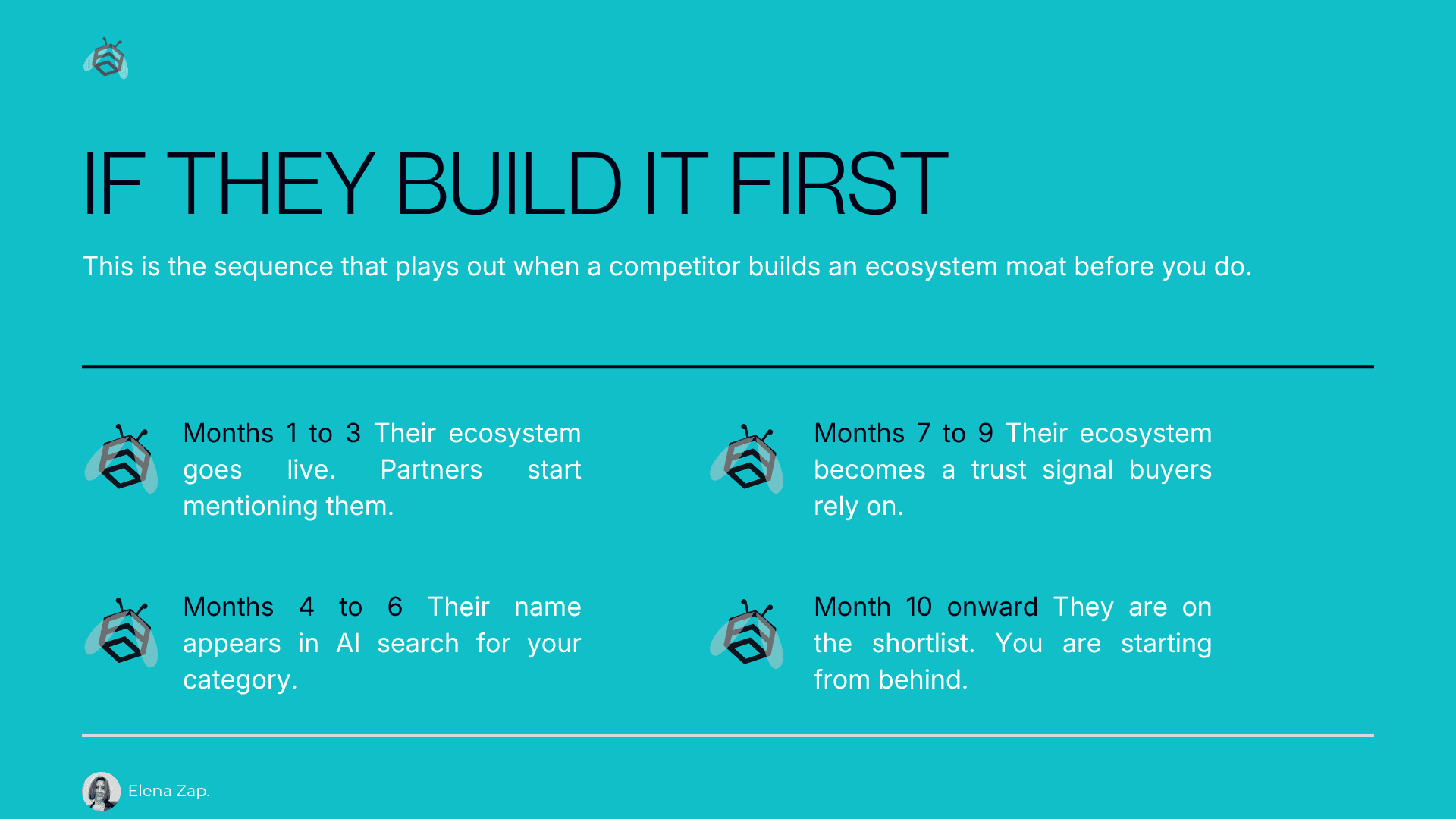
The sequence is predictable:
Months 1 to 3. Their ecosystem goes live. Partners start mentioning them in conversations and content.
Months 4 to 6. Their name appears in AI search results for your category. Buyers researching the space find them, not you.
Months 7 to 9. Their ecosystem becomes a trust signal buyers rely on during evaluation. Multiple partner references confirm the recommendation.
Month 10 onward. They are on the shortlist. You are starting from behind.
The difficulty of reversing this position is not theoretical. Shortlists formed during independent research are rarely revised after the formal evaluation starts. Getting added after the list is formed almost never happens.
The Four Infrastructure Components That Build an Ecosystem Moat
Four components work independently and compound together.
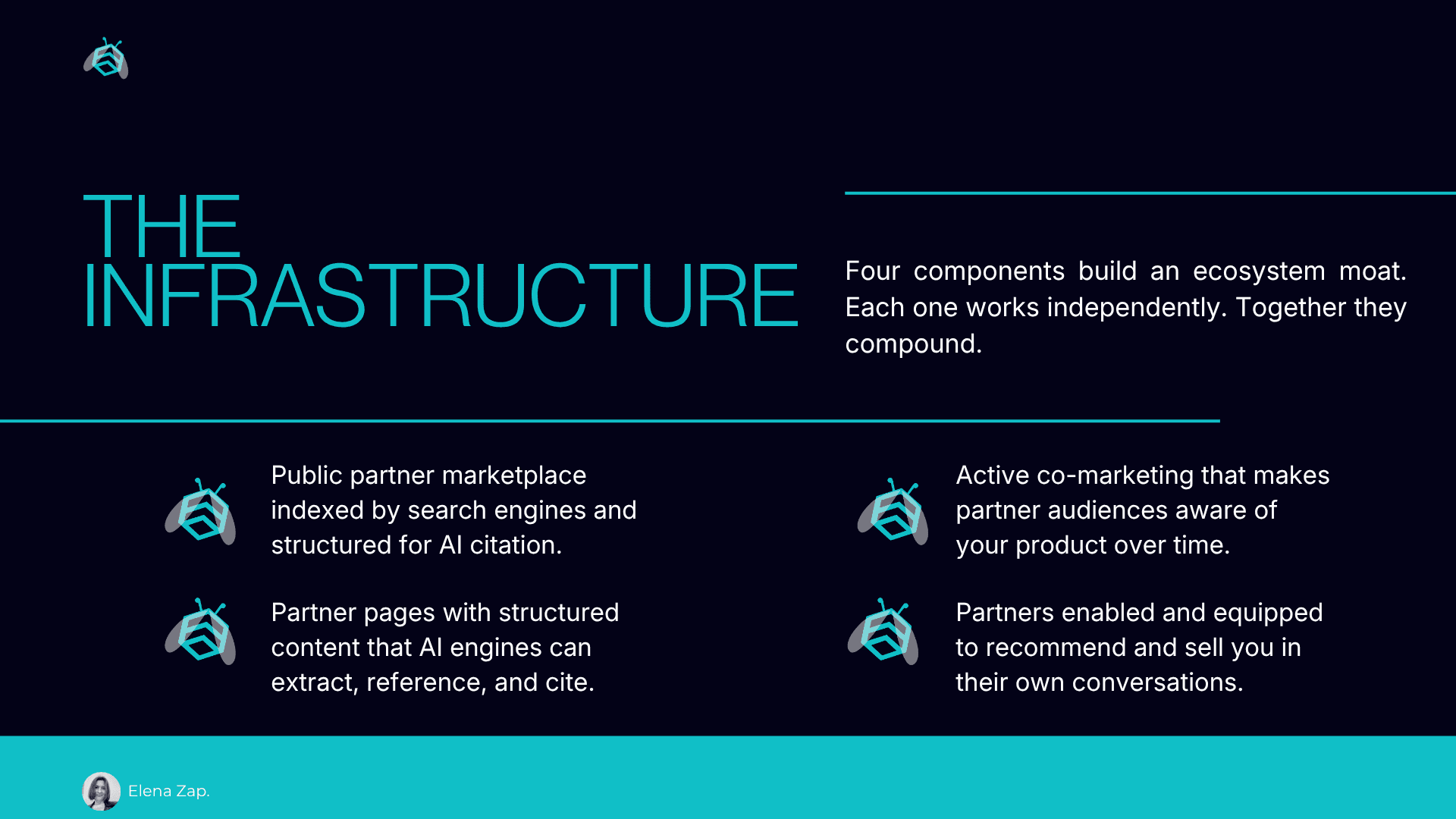
Public partner marketplace indexed by search engines and structured for AI citation.
This is the foundation. A public marketplace creates the crawlable, citable surface that search engines and AI assistants extract from. A private partner page does not do this.
Partner pages with structured content that AI engines can extract, reference, and cite.
Each partner page needs enough structured content to be useful as a citation source. Partner name, category, integration description, use case, and mutual customer benefit at minimum.
Active co-marketing that makes partner audiences aware of your product over time.
Co-marketing turns the structural relationship into active distribution. This includes joint content, partner newsletters, co-branded campaigns, and consistent cross-promotion across both parties' channels.
Partners enabled and equipped to recommend and sell you in their own conversations.
Enablement closes the loop. A partner who understands your value proposition and has materials to share becomes an active distribution node. Without enablement, even enthusiastic partners stay quiet when the opportunity comes up.
How to Start Building an Ecosystem Moat
You do not need a partnerships team to start. Ecosystem infrastructure is a build decision.
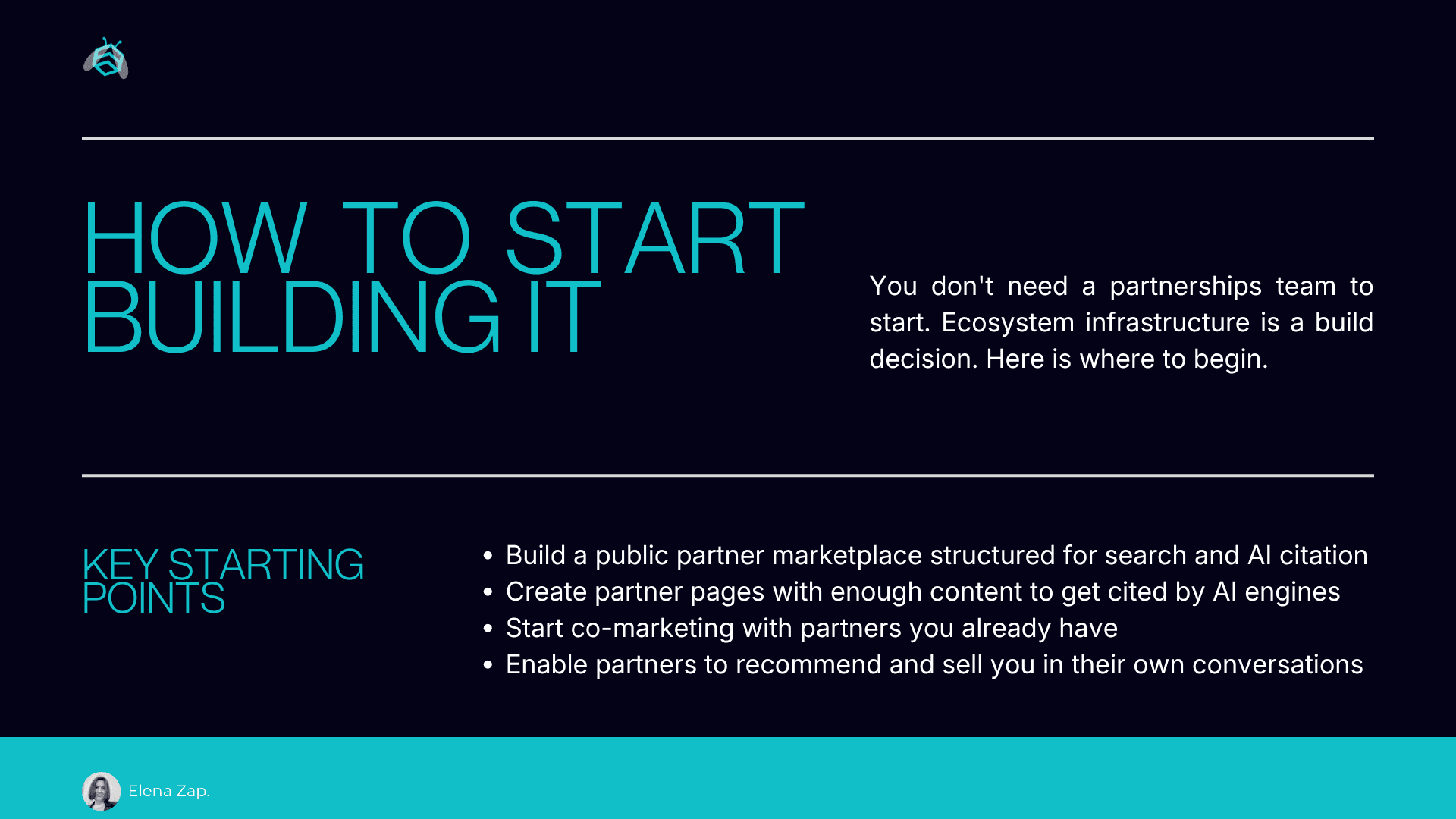
Four starting points, in order of priority:
Build a public partner marketplace structured for search and AI citation. This is the surface everything else depends on.
Create partner pages with enough structured content to get cited by AI engines. Thin pages do not get extracted.
Start co-marketing with partners you already have. You do not need new partners to start. Activate the ones you have.
Enable partners to recommend and sell you in their own conversations. Give them what they need to do it without friction.
Bonobee builds this infrastructure for B2B tech companies. The partner marketplace goes live in weeks, not quarters.
Quick Reference: Ecosystem Moat Definitions and Distinctions
Ecosystem moat: A competitive advantage built through visible partner relationships, integrations, and co-marketing that makes a product difficult to displace during buyer research.
What it is not: A list of signed partner agreements, a static partner page, or technical integrations without co-marketing.
How it works: It creates discoverability during the independent research phase of the B2B buying journey, before a buyer contacts a sales team.
Why it compounds: Each new partner expands reach into new audiences. Infrastructure builds over time. Distribution grows without proportional headcount or ad spend increases.
Why it matters in 2026: AI assistants now surface products during buyer research. Products that are not visible in structured, citable ecosystems are not surfaced. The advantage goes to whoever builds the infrastructure first.
Frequently Asked Questions
What is an ecosystem moat in B2B?
An ecosystem moat is a competitive advantage built through visible partner relationships, integrations, and co-marketing. It makes a product difficult to displace because buyers encounter it repeatedly through trusted third parties during independent research, before they contact the vendor's sales team.
How is an ecosystem moat different from having partners?
Having partners means you have signed agreements. An ecosystem moat means those partners are actively visible, co-marketing, and recommending you in searchable, AI-citable ways. The moat requires infrastructure: a public partner marketplace, structured partner pages, active co-marketing, and partner enablement. Agreements alone do not create this.
Why do B2B buyers research independently before talking to sales?
B2B buyers conduct independent research to build a shortlist before engaging vendors. Forrester research indicates 81% of the buying journey is independent research. Buyers want to form their own view before entering a sales conversation. This is why ecosystem visibility during that pre-sales window determines whether a company gets considered.
Can you build an ecosystem moat without a partnerships team?
Yes. Ecosystem infrastructure is a build decision, not a headcount decision. A company can launch a public partner marketplace, create structured partner pages, and begin co-marketing with existing partners before making any partnerships hire. The infrastructure creates the foundation that a future team operates on.
What happens if a competitor builds an ecosystem moat before you?
The competitor gains search and AI visibility for your category, earns partner-based trust signals, and lands on buyer shortlists ahead of you. Research from Gartner indicates 95% of deal winners are on the buyer's initial shortlist. Reversing a shortlist position after evaluation begins is rare. The first-mover advantage in ecosystem visibility is structural, not temporary.
How long does it take to build an ecosystem moat?
The infrastructure can be live in weeks. The compounding effects build over 6 to 18 months as partners co-market, content gets indexed, and AI assistants begin citing the ecosystem consistently. The earlier the infrastructure is built, the longer it has to compound before a competitor builds theirs.
What is the role of AI search in ecosystem moats?
AI assistants surface vendors during buyer research. They cite structured, visible content. A partner ecosystem with a public marketplace and structured partner pages is crawlable and citable. An ecosystem that exists only in CRM records or private portals is not. In 2026, AI search discoverability is a core component of ecosystem moat strategy, not a separate SEO concern.
Build Yours Before a Competitor Does
If you already have partners, the infrastructure work can start immediately. You do not need new relationships. You need the visibility layer around the ones you have.
See your partner marketplace live. Book a call at bonobee.ai

Elena Zap
Co-founder & CEO

