
Stay tuned on LinkedIn to be the first to hear about our updates!
A partner directory can be one of the most effective inbound channels for partner acquisition. It can also sit completely unnoticed for months while you wonder why no one is applying to your program.
The difference is not the design. It is the infrastructure behind it and the operational commitment to keep it running.
Quick Answer
A partner directory is a searchable, public-facing section of your website where potential partners can find your program, understand what you offer, and apply to join.
A directory that attracts inbound applications needs structured partner profiles, a clear application flow, SEO and AEO optimization, and active ongoing management. Building the initial page is straightforward. Keeping it visible, current, and converting is where most programs fail.
What a partner directory is
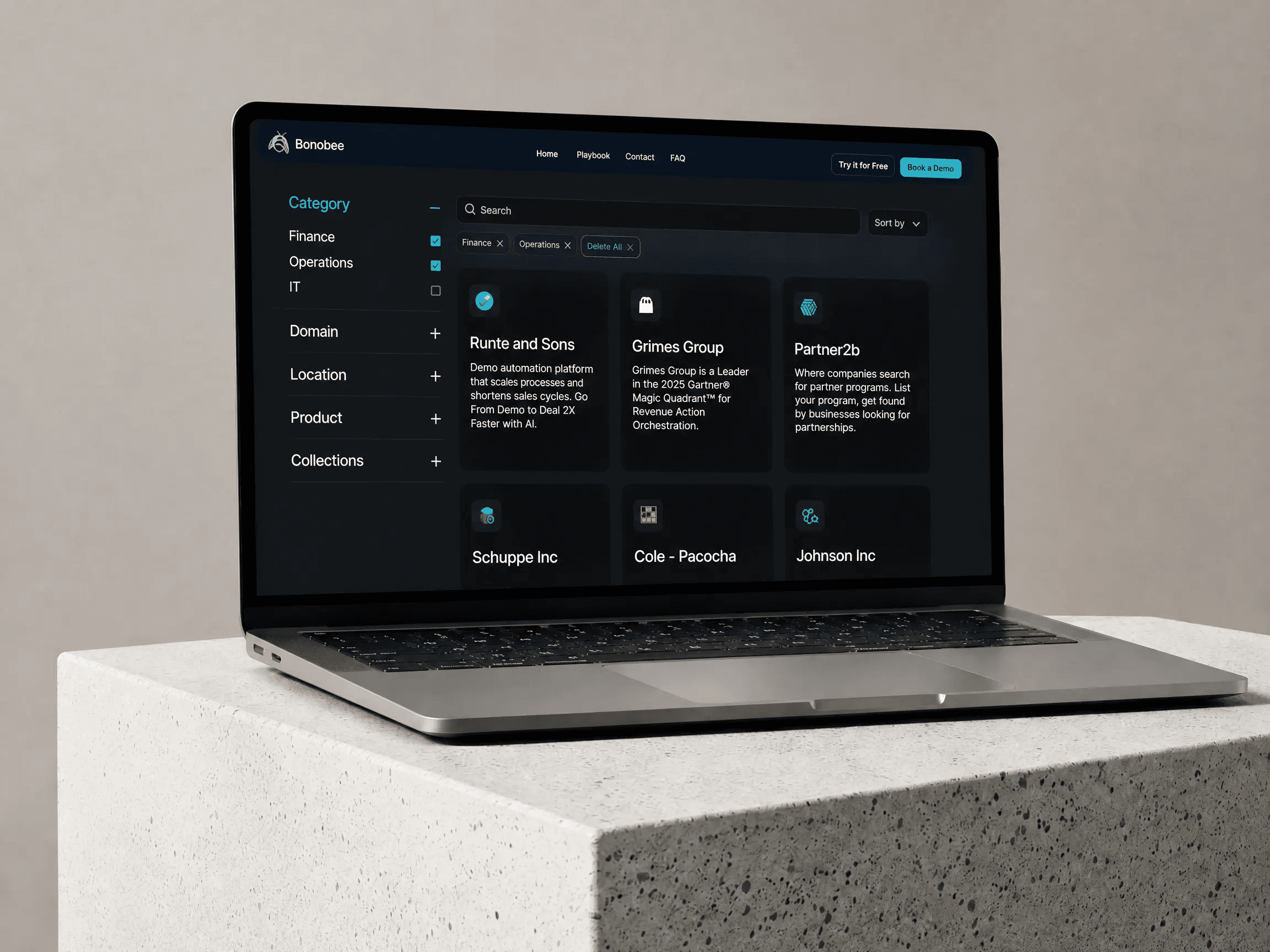
A partner directory is a live, searchable section of your website that makes your partner program visible to potential partners, buyers, and AI search engines. It gives partners a way to find your program, understand what you offer, and apply to join. It gives buyers a way to verify that your ecosystem exists and find the right partner for their needs.
It is not a logos page. It is not a PDF. It is not a list buried in your website footer.
What counted as a functional partner directory in 2025 no longer meets the bar in 2026. AI search engines changed the rules. ChatGPT, Perplexity, and Google AI Overviews now answer questions about partner ecosystems directly, pulling from structured, current content. A directory that was not built for that environment is effectively invisible to a growing share of the people looking for it.
Partner directory in 2025 | Partner directory in 2026 | |
|---|---|---|
Search optimization | Google SEO only | SEO plus AEO for AI assistants |
Partner profiles | Static text listings | Indexed individual pages with schema markup |
Discoverability | Search engines only | Search engines plus ChatGPT, Perplexity, Google AI Overviews |
Content updates | Occasional, manual | Regular, structured for AI extraction |
Application flow | Contact form or email | Dedicated flow with partner type tracks |
Performance tracking | Page views only | Partner activity, deal registration, pipeline attribution |
Why most partner directories do not generate applications
Most partner directories fail before they generate a single inbound application. The reasons are structural, not cosmetic.
No partner type separation.
Agencies, technology partners, and resellers all land on the same page with no differentiation and no relevant call to action for each type.No AEO structure.
The directory exists as a single page rather than a set of indexed, optimized profiles that AI assistants can extract and cite individually.No application flow.
Interested partners find the directory and have nowhere to go. No form, no criteria, no defined next step.Missing program details.
Commission structure, partner benefits, and onboarding process are either absent or gated behind a sales conversation. Partners who self-qualify need this information before they reach out.Built once, never updated.
Partner profiles go stale. Program information reflects a previous version of the offering. The page signals that the program may no longer be active.
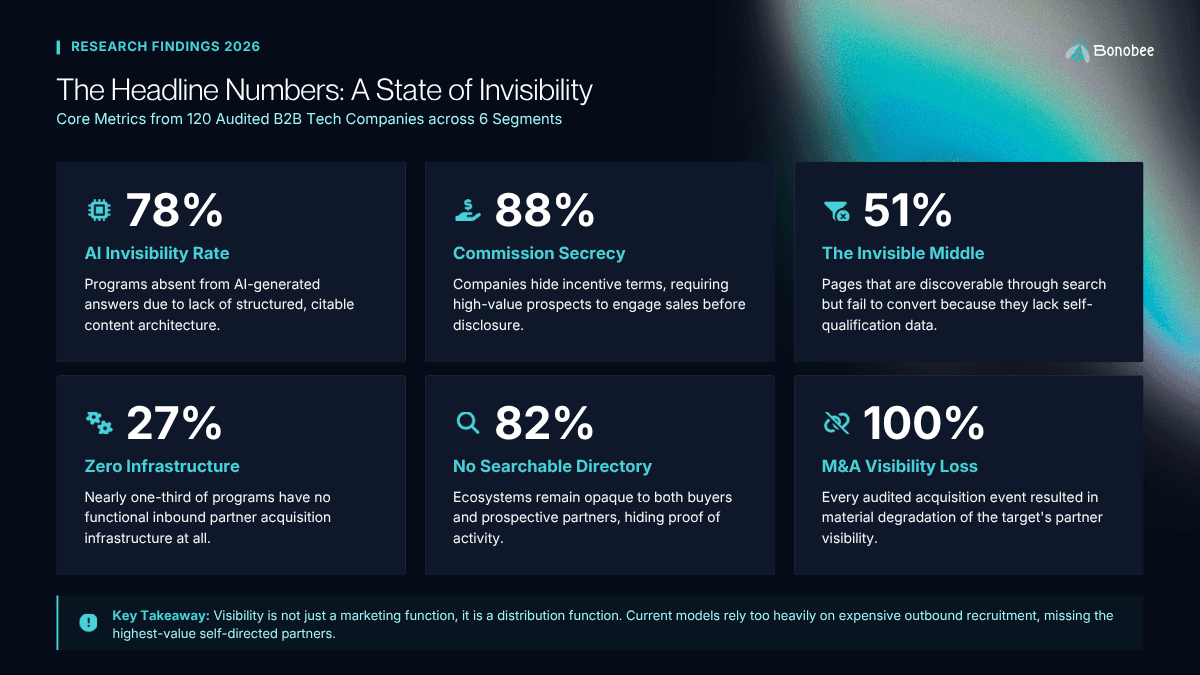
According to the State of Partner Ecosystem Visibility 2026, 78% of mid-market B2B tech companies have partner programs that are invisible to AI search engines. Directory structure is one of the primary causes.
What your partner directory needs to include
Before building anything, get clarity on each of these components. This is not a technical blueprint. It is a scope check.
1. Separate partner type tracks
Agencies, technology partners, resellers, and integration partners have different motivations and different qualification criteria. A single generic page converts none of them effectively.
2. Individual partner profiles
Each partner needs a dedicated indexed page, not a row in a table. A page can rank on Google and be cited by AI assistants. A row in a table cannot.
3. A structured application flow
Interested partners need a clear path from discovery to application. Visible eligibility criteria, a form, and a defined response process are all required.
4. Public program information
What partners receive, what is expected of them, and how the program works. Leaving this out creates friction and loses the partners most likely to self-qualify.
5. AEO-structured content
FAQ sections, step-by-step descriptions, and schema markup that allow AI engines to extract and cite your program information accurately.
6. Analytics and tracking
Page views, application submissions, partner referral traffic, and deal registration volume. Without measurement, you cannot improve what is not working.
How most companies try to build a partner directory
There are three common approaches. Each comes with an honest operational reality.
Approach | What it delivers | Where it breaks down |
|---|---|---|
In-house build | Full control, custom logic | Competes with product roadmap. Launches once, never gets updated. |
No-code tools (Loveable, Framer, Webflow) | Fast launch, good design | No application logic, no AEO schema, no analytics, no update workflow. Looks functional on day one, becomes outdated within weeks. |
Dedicated ecosystem infrastructure | Built for this job end-to-end | Higher starting investment, but the only option that keeps working after launch. |
The pattern is consistent across all three approaches. Something gets launched. It looks functional. And then the operational reality sets in.
A directory without application logic has nowhere to send interested partners. A directory without AEO schema is invisible to AI search. A directory without an update workflow reflects a program that stopped evolving the day it went live.
The tool used to build it is rarely the problem. The absence of infrastructure to run it always is.
What maintaining a partner directory actually takes
This is where most companies get it wrong. Building the directory is a one-time project. Running it is an ongoing operational commitment. The two are not the same thing.
Partner profiles go stale.
Partners rebrand, change their focus, update their offerings, and sometimes leave your program. Every outdated profile is a credibility problem with the next partner who lands on your directory. Someone needs to own profile accuracy on a regular basis.
Applications require active management.
When partners apply, they expect a response. An unanswered application is a lost partner relationship. The application flow needs a defined owner, a review cadence, and a follow-up process.
SEO requires ongoing optimization.
Search rankings are not permanent. Keyword relevance shifts, competitors publish content targeting the same queries, and pages that ranked six months ago can drop without warning. Partner directory SEO is not a setup task. It is a continuous activity.
AEO requires structured content updates.
AI engines like ChatGPT, Perplexity, and Google AI Overviews pull answers from structured, current content. As your program evolves, the content that AI engines extract needs to reflect that. Static content gets deprioritized. Updated, structured content gets cited.
The program itself changes.
New partner types get added. Commission structures get revised. Onboarding processes improve. Every change to your program that is not reflected in the directory creates a gap between what partners expect and what they find. That gap costs you applications.
The State of Partner Ecosystem Visibility 2026 found that only 22% of the 120 mid-market B2B tech companies audited met all five best-practice criteria for running an active inbound partner acquisition channel. Ongoing maintenance was a defining factor separating that 22% from the rest.
What happens when you do not maintain it
A neglected partner directory does not stay neutral. It actively works against your program.
Potential partners land on stale profiles and assume the program is inactive
AI search engines stop citing your directory because the content is no longer fresh or structured
Inbound applications slow down and eventually stop
Existing partners notice their profiles are outdated and lose confidence in the program
Your ecosystem becomes invisible at exactly the moment buyers are evaluating your category
A directory that looked like an asset at launch becomes a liability within months if no one is running it.
Everything You Wanted to Know About Partner Directories
What is a partner directory?
A partner directory is a searchable, public-facing section of a company's website that lists its partner ecosystem, allows filtering by partner type, region, and specialization, and provides a path for new partners to apply to join the program. A functional partner directory in 2026 is indexed by search engines and structured for AI assistant extraction.
How is a partner directory different from a partner marketplace?
A partner directory lists existing partners and makes the ecosystem searchable. A partner marketplace goes further by adding lead capture on partner profiles, co-sell functionality, performance analytics, and revenue attribution. A directory makes your ecosystem visible. A marketplace makes it a revenue channel.
What does it take to maintain a partner directory?
Maintaining a partner directory requires regular partner profile updates, active application management, ongoing SEO and AEO optimization, and program information that stays current. Without ongoing maintenance, directories go stale and stop generating inbound activity within months.
Can I build a partner directory with a no-code tool?
You can build a page that looks like a partner directory using tools like Loveable, Framer, or Webflow. What you cannot build with these tools is the application management logic, AEO schema structure, partner profile update system, and analytics layer that a functional partner directory requires. The result is a well-designed static page, not an inbound channel.
What makes a partner directory visible to AI search in 2026?
AI assistants extract answers from structured, current content. A partner directory becomes visible to AI search through FAQ schema markup, step-by-step onboarding descriptions, individual indexed partner profiles, and regular content updates. A static directory page with no schema and no updates will not be cited by AI engines regardless of how well it was designed at launch.
How do I know if my partner directory is working?
Track inbound partner applications per month, partner profile page traffic, AI citation presence for relevant queries, and deal registration volume from partners. A directory that is working generates a measurable and growing number of inbound applications without manual outreach.
Quick reference
Partner directory: a searchable, indexed, public-facing partner program infrastructure with individual profiles, partner type tracks, application flow, and ongoing management
2025 vs 2026: what changed is not the concept but the optimization requirement. SEO alone is no longer enough. AEO for AI search is now a core requirement.
AEO: Answer Engine Optimization, the practice of structuring content so AI assistants can extract and cite it accurately
The maintenance reality: SEO, AEO, profile updates, application management, and program content updates are all ongoing requirements, not one-time tasks
What no-code tools cannot do: application logic, AEO schema, partner profile management, analytics, and update workflows
Ready to build a partner directory that actually works
If this article made one thing clear, it is that the build is the smaller part of the challenge. The infrastructure behind it and the system to keep it running are what determine whether your directory generates applications or just exists.
Bonobee is the ecosystem infrastructure platform built specifically for this job. Partner profiles, application flows, AEO optimization, analytics, and ongoing management are all included, not added on later.
Book a call to see how it works

Elena Zap
Co-founder & CEO

