
Stay tuned on LinkedIn to be the first to hear about our updates!
AI partner discovery is the use of machine learning and automation to identify, evaluate, and attract potential partners for a B2B tech company's ecosystem. Instead of manually researching companies, cold outreaching to mismatched prospects, or relying entirely on inbound applications, AI partner discovery uses data to surface the right partners at the right time.
In practice, it means your partner program gets smarter over time. The system learns what good partners look like based on existing high-performers, then identifies similar candidates automatically. It scores applicants before a human reviews them. It surfaces recommendations to buyers inside your partner marketplace based on what they're actually trying to accomplish.
The result: less time spent on low-fit conversations, more time spent building relationships that convert.
Why Manual Partner Sourcing Breaks Down at Scale
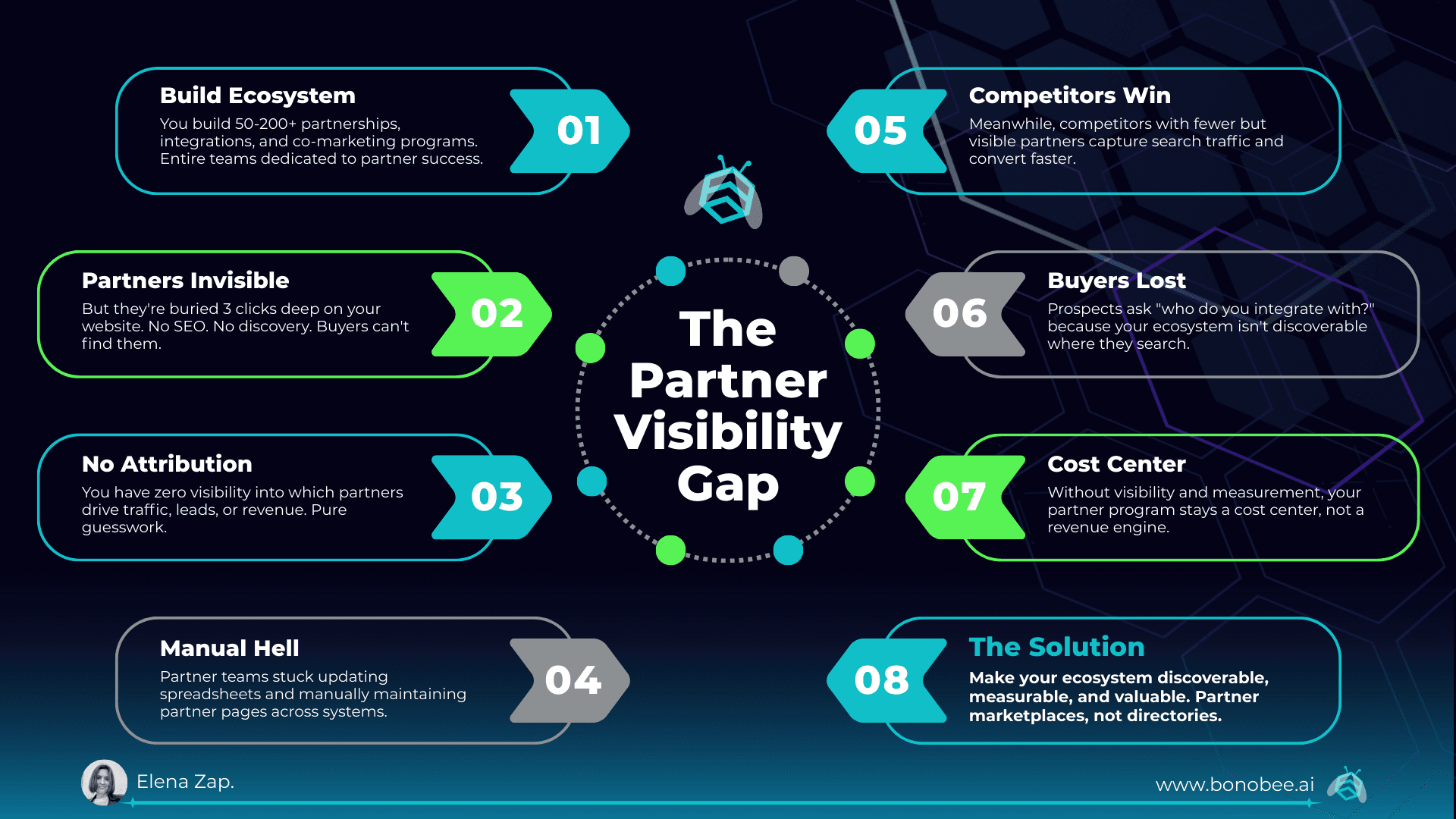
Most B2B partner teams build ecosystems the hard way. Fifty to two hundred partnerships, integrations, and co-marketing programs. Entire teams dedicated to partner success. And then nothing to show for it where it counts.
The visual above maps exactly what happens next, and it's a loop most partnership leaders recognize immediately.
Partners get buried three clicks deep on your website. No SEO, no discovery, no way for buyers to find them without already knowing to look. Meanwhile, your team has zero visibility into which partners drive traffic, leads, or revenue. Pure guesswork. Partner managers spend their days updating spreadsheets and manually maintaining pages across systems instead of building relationships.
The downstream effects compound fast. Competitors with fewer but visible partners capture search traffic and convert faster. Prospects ask "who do you integrate with?" in the demo because your ecosystem wasn't discoverable where they were researching. Without measurement, the program stays a cost center. No attribution means no case for investment.
Step 08 in the diagram names the fix: make your ecosystem discoverable, measurable, and valuable. Partner marketplaces, not directories. That's the infrastructure shift. AI partner discovery is what makes that infrastructure intelligent.
The problems run deeper than workflow inefficiency:
Volume. The number of potential partners in any B2B tech ecosystem is enormous. Technology integrations, resellers, referral partners, agency partners, co-sell partners. Manually evaluating all of them is unsustainable.
Signal quality. A company's website, LinkedIn presence, and partner application don't tell you whether they're actually a good fit. You need behavioral signals: who their customers are, what integrations they already have, where they overlap with your ICP, how actively they promote other partnerships.
Discoverability runs both ways. You're not just trying to find partners. Partners are also trying to find you. If your ecosystem isn't visible and searchable, the best potential partners may never find you at all. They'll find a competitor with a public, well-structured partner marketplace instead.
Lack of attribution. Without data, you don't know which partners actually drive revenue. That makes it impossible to recognize patterns, double down on what works, or replicate high-performing relationships.
Manual processes can't solve any of these systematically. AI can.
What AI Partner Discovery Actually Does
AI partner discovery isn't one thing. It's a set of capabilities that work together across the partner lifecycle.
Partner matching and scoring
When a company applies to your partner program, AI can automatically classify them by partner type, evaluate their fit against your ICP, and score them before a human reviews the application. Instead of reviewing 40 applications with no prioritization, your team sees a ranked list with the highest-fit candidates at the top.
Matching goes the other direction too. AI can proactively surface companies you should be recruiting, based on signals like existing integrations, shared customer segments, or complementary product positioning.
Personalized partner recommendations for buyers
Inside a partner marketplace, AI can surface the right partners to the right buyers at the right time. A buyer searching for a billing automation solution gets recommendations tailored to their query, not a flat alphabetical list of 200 partners.
This matters because most buyers don't browse through an entire partner directory. They search for something specific, and if the relevant result isn't immediately visible, they leave. AI recommendations solve that without requiring buyers to know exactly what to search for.
Automated onboarding workflows
Once a partner is approved, AI can suggest onboarding steps, generate their partner page content, recommend co-marketing templates, and flag what's missing from their listing. This cuts onboarding time significantly and removes a manual bottleneck that slows down partner activation.
Content generation and SEO optimization
Each partner in your ecosystem should have their own indexed, optimized page. AI can generate those pages: descriptions, tags, metadata, value propositions, integration summaries. For a company with 100+ partners, doing this manually is months of work. With AI, it happens at the point of onboarding.
Performance signals and predictive insights
AI analyzes which partners are driving traffic, leads, and pipeline. It identifies patterns in high-performing partnerships before your team has manually noticed them. It can predict which newer partners are likely to become high-performers based on early signals, letting you invest in them earlier.
The Visibility Problem AI Discovery Can't Solve Alone
Here's something that gets overlooked in most conversations about AI partner tools: none of this works if your ecosystem isn't discoverable in the first place.
AI-powered partner matching inside your partner portal helps partners who are already in your program. AI recommendations inside your marketplace help buyers who have already found your marketplace. But if your partner ecosystem is buried behind a login wall, hidden on a static "Partners" page, or living in a PDF, none of those AI capabilities matter for inbound acquisition.
The starting point for effective AI partner discovery isn't the algorithm. It's visibility infrastructure.
A public, indexed partner marketplace means:
Potential partners can find you organically. They search "your product + integration" or "your product + partner program," and they land on a page that clearly explains what partnership looks like, who your current partners are, and how to apply.
Buyers discover your ecosystem during their research phase. They're evaluating you against competitors. Your visible, searchable ecosystem becomes a proof point for product depth and market trust.
Every partner page creates an SEO signal. Atlassian, Klaviyo, Cloudflare, Gong, and Stripe all built public partner marketplaces. The SEO value of those pages compounds over years. Companies that wait are handing search traffic to competitors.
AI partner discovery operates most effectively when it sits inside a publicly visible, well-structured partner marketplace. The marketplace creates the discovery surface. The AI makes the experience inside that surface smarter.
How AI Partner Matching Works in a Partner Marketplace
To make this concrete, here's how AI partner matching works inside a well-built partner marketplace.
For inbound partner applicants:
A company submits an application to join your partner program. The system automatically classifies them (technology integration, reseller, referral, agency), scores their fit against your defined partner profiles, and routes them to the appropriate review queue. Your partnerships team sees a prioritized list, not an undifferentiated inbox.
For partner page optimization:
Once approved, the partner submits their information. AI generates their marketplace listing: a structured description, integration summary, use case tags, and SEO-optimized metadata. The partner can review and edit, but the heavy lifting is done. Their page goes live quickly and is immediately indexed.
For buyers browsing the marketplace:
A prospect visits your partner marketplace looking for a data analytics integration. Instead of scrolling through alphabetical listings, they see a filtered, recommended set based on their search intent. If they engage with one partner listing, AI surfaces related partners they might not have found otherwise.
For your partnerships team:
The analytics dashboard shows which partner pages are getting traffic, which are generating lead form submissions, and which partners are influencing pipeline. AI surfaces which partnerships are underperforming relative to their potential and flags optimization opportunities.
This is the difference between a partner directory (static, manual, no intelligence) and an AI-powered partner marketplace (dynamic, automated, improving over time).
What to Look for in an AI Partner Discovery Tool
The questions that matter most aren't about the AI itself. They're about the infrastructure around it.
Is your ecosystem publicly discoverable? Tools that only operate inside a private partner portal create a closed loop. You get efficiency for existing partners, but no inbound surface for new ones.
Does it generate indexable partner pages? Every partner should have a public, SEO-optimized page on your domain. If your tool doesn't create those pages, you're missing the compounding SEO value of your entire ecosystem.
Can you attribute partner-influenced revenue? Make sure the platform tracks which partner pages drive traffic, which generate leads, and which contribute to closed deals.
Does it reduce manual work for your team? Onboarding, content generation, application routing, performance reporting: these are all areas where AI should be doing the heavy lifting.
Does it improve over time? A static matching algorithm isn't really AI partner discovery. The system should learn from your ecosystem's performance data and improve its recommendations as more partnerships are activated and measured.
The Ecosystem as a Competitive Asset
There's a strategic dimension to AI partner discovery that often gets missed in tactical conversations about tooling.
Your partner ecosystem is part of your value proposition. When a prospect is evaluating you against a competitor, one of the things they're evaluating is: who does this vendor work with, and does that ecosystem make the product better for me?
Companies that make their ecosystem visible, searchable, and continuously optimized turn it into a competitive asset. Companies that keep it hidden or manual turn it into a cost center.
AI doesn't change that fundamental logic. But it does change how quickly you can build, scale, and optimize your ecosystem. Partner programs that used to require a team of five to manage 200 partnerships can now run leaner. Ecosystems that used to take years to build can compound faster.
The companies investing in AI partner discovery infrastructure in 2026 are building moats. The ones waiting are watching that moat get built by someone else.
Quick Reference: AI Partner Discovery Capabilities
What AI partner discovery includes:
Automated partner scoring and classification on application
Proactive partner recruitment recommendations
Personalized partner recommendations for marketplace buyers
AI-generated partner page content and SEO metadata
Automated onboarding workflows and activation suggestions
Performance analytics and predictive insights on partner value
What AI partner discovery requires to work effectively:
A public, indexed partner marketplace (not a private portal)
Structured partner data (company type, ICP overlap, integration details)
Clear partner tier definitions and ideal partner profiles
Attribution tracking connected to pipeline and revenue data
What AI partner discovery replaces:
Manual application review with no prioritization
Spreadsheet-based partner tracking
Generic, unoptimized partner directory pages
Reactive partner recruitment (waiting for inbound only)
Frequently Asked Questions
What is AI partner discovery? AI partner discovery uses machine learning to identify, evaluate, and attract potential partners for a B2B tech company. It automates partner scoring, surfaces recruitment candidates, and personalizes partner recommendations for buyers inside a partner marketplace.
How is AI partner matching different from manual partner recruitment? Manual partner recruitment relies on personal networks and reactive inbound applications. AI partner matching uses behavioral and firmographic data to proactively surface high-fit candidates, score applicants automatically, and identify patterns in successful partnerships that can be replicated.
Does AI partner discovery require a large existing partner ecosystem to work? No, but it improves with scale. You can start with AI-assisted onboarding and content generation for a small ecosystem, then add matching and predictive analytics as you accumulate more partner and performance data.
What's the difference between an AI partner marketplace and a partner directory? A partner directory is a static list. An AI partner marketplace is a dynamic platform that surfaces personalized recommendations, generates indexed partner pages, tracks performance attribution, and improves over time based on ecosystem data.
Can AI partner discovery help with inbound partner acquisition? Yes, but only if it's paired with a public, SEO-optimized partner marketplace. AI that operates only inside a private portal doesn't create an inbound discovery surface. The public marketplace is what drives inbound partner interest from organic search.
Build a Partner Ecosystem That Finds Partners for You
Manual partner sourcing has a ceiling. At some point, the number of potential partners you could be working with exceeds what any team can manage manually. AI partner discovery removes that ceiling.
But the infrastructure has to come first. A public, indexed, SEO-optimized partner marketplace is the foundation. AI makes it smarter. Together, they turn your partner program from a cost center into a compounding growth channel.
Bonobee builds AI-powered partner marketplaces for B2B tech companies. If your partner ecosystem is still buried behind a login wall or living on a static page, see what it looks like live.

Elena Zap
Co-founder & CEO

