
Stay tuned on LinkedIn to be the first to hear about our updates!
Two terms get used interchangeably in AI buying conversations that describe two different roles: AI vendor and AI implementation partner. Confusing them leads to a specific, expensive outcome: a company ends up owning a piece of technology with no one accountable for making it work inside their actual business.
This article defines both terms clearly, explains why the distinction has become more consequential in the agentic AI era, and outlines the practical questions that reveal which one you're actually talking to.
What an AI vendor is
An AI vendor sells a product: a platform, a model, a tool, or a licensed piece of software. The vendor's obligation is to the technology itself. Once the license is issued and the product is delivered, the engagement is largely complete.
A vendor's core responsibilities typically include:
Building and maintaining the underlying technology
Providing documentation and initial onboarding
Fixing defects in the product itself
Supporting the platform through updates and version changes
What a vendor is not typically responsible for is whether the product functions well inside a specific customer's systems, data environment, or day-to-day workflows. That responsibility sits with the buyer, unless a separate party takes it on.
What an AI implementation partner is
An AI implementation partner is accountable for outcomes, not just delivery. Instead of shipping a defined scope and closing the engagement, an implementation partner takes ownership of getting a system to function correctly inside a specific business: its data, its existing software stack, its teams, and its operational constraints.
An implementation partner's core responsibilities typically include:
Assessing readiness before any technology is selected or deployed
Integrating the system with existing infrastructure
Managing the transition from pilot to production
Supporting adoption across the teams who will actually use the system
Remaining accountable after go-live, not only through delivery
The engagement doesn't end when the system is technically functional. It ends when the system is in productive, ongoing use.
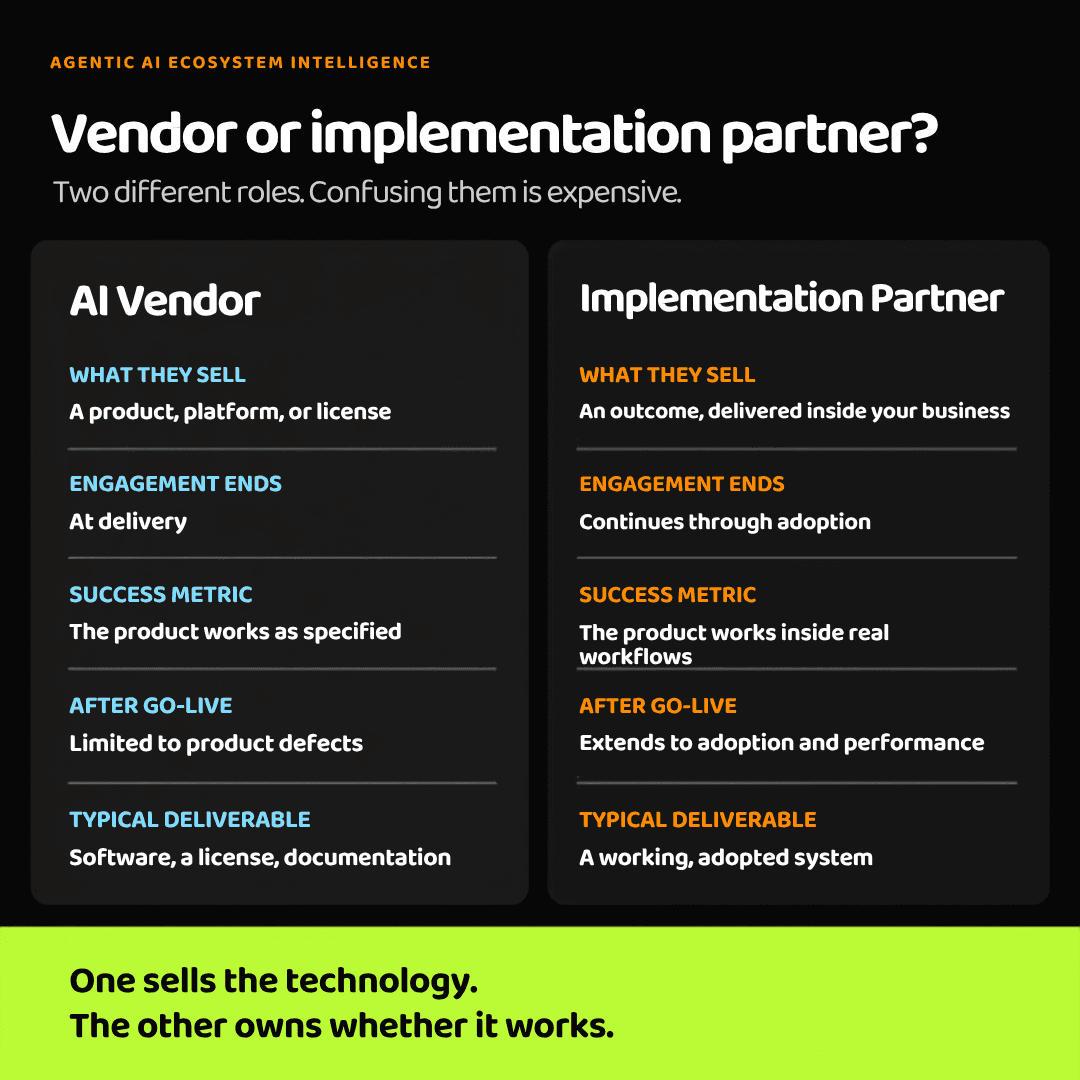
AI vendor vs. implementation partner: a direct comparison
AI Vendor | Implementation Partner | |
|---|---|---|
What is sold | A product, platform, or license | An outcome, delivered inside a specific business |
Point of engagement end | At delivery | Continues through integration and adoption |
Primary success metric | The product functions as specified | The product functions inside real workflows |
Accountability after go-live | Limited to product defects | Extends to adoption and ongoing performance |
Typical deliverable | Software, a license, documentation | A working, adopted system |
Why buyers confuse the two roles
The confusion is understandable. Some companies offer both functions under one name, some vendors provide light implementation services alongside their product, and marketing language across the AI industry rarely draws a clean line between "we built this" and "we'll make this work for you."
The distinction becomes visible at one specific moment: what happens after the system is technically live. A vendor's obligation typically ends there. An implementation partner's obligation typically begins in earnest at that point.
Why this distinction matters more with AI agents
The stakes of this confusion have increased with the shift toward agentic AI, and the data explains why.
Gartner projects that over 40% of agentic AI projects will be canceled by the end of 2027. The firm attributes this to three causes: escalating costs, unclear business value, and inadequate risk controls. None of these are model or platform failures. Each one is an implementation and governance failure, the exact category of work that falls to an implementation partner rather than a vendor.
Separately, MIT's Project NANDA found that just 5% of integrated AI pilots are extracting measurable value, with the majority showing no measurable impact on the business. A capable underlying model does not resolve this gap on its own. Closing it requires the ongoing, business-specific work an implementation partner is structured to provide.
A deeper breakdown of where these projects tend to fail is available in 45+ AI Agent Implementation Facts: The Data Behind Why Pilots Fail, and the specific case for pairing AI vendors with implementation partners is covered in Why AI Agent Companies Can't Scale Without Implementation Partners.
The evaluation problem this creates
A vendor's technology and an implementation partner's ability to deploy it are two separate variables, and the buying process usually forces them to be evaluated separately. A company selects a vendor based on the platform's capabilities, then separately selects, or is assigned, an implementation partner to make it work. Compatibility between the two is often discovered only after both commitments are already made.
This is the structural gap behind a large share of agentic AI project failures: not a weak vendor, and not a weak implementation partner, but a mismatch between the two that nobody evaluated together before signing.
Bonobee's platform is built around exactly this problem, evaluating AI agent vendors and their implementation partners together instead of as two disconnected decisions. More detail on how that works is available on the Bonobee platform overview and why the agentic AI ecosystem needs this layer.
How to identify which role you're evaluating
The following questions reliably distinguish a vendor from an implementation partner during a sales conversation:
Does the engagement end at delivery, or does it continue through adoption?
Is success defined as "the product works," or as "the team is using it"?
Can the organization name the specific people who will build inside your environment, separate from the people running the sales process?
Who is responsible if the system underperforms after go-live?
Is the proposed deliverable working software, or a strategy document and roadmap?
Does compensation depend on adoption, or only on delivery?
An organization whose answers point toward "the technology, not the outcome" is operating as a vendor. An organization whose answers point toward ongoing accountability is operating as an implementation partner.
Summary
An AI vendor is responsible for the technology. An AI implementation partner is responsible for the outcome. Treating these as the same role, or assuming one company can fully perform both functions without being evaluated for each separately, is a common and costly mistake in AI buying decisions, one that has grown more consequential as agentic AI systems have made the gap between "the model works" and "the business works" harder to close after the fact.
Companies evaluating AI agent vendors and implementation partners together, verified and matched by fit, can start with a free search on Bonobee's directory or join the waitlist for early access before public launch.

Elena Zap
Co-founder & CEO

