
Stay tuned on LinkedIn to be the first to hear about our updates!
Enterprise AI agent spending crossed $37 billion in 2025, yet Gartner projects over 40% of these projects will be canceled by 2027. The gap between spend and success comes down to implementation, not model quality.
Here are 45 facts on adoption, governance, and the partner effect, each sourced and linked.
Market size and growth
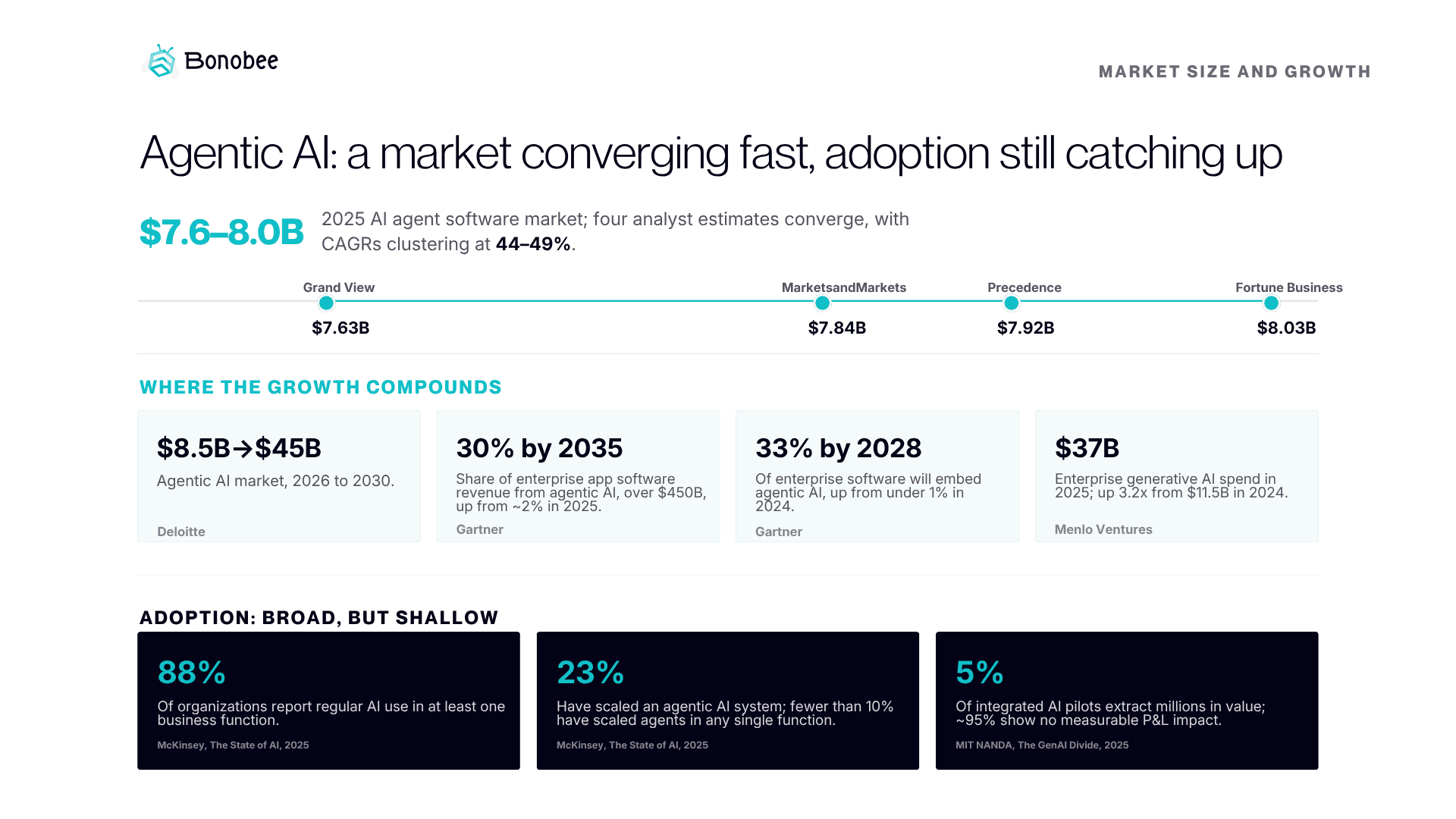
The AI agent software market is $7.6 to $8.0 billion in 2025, converging across Grand View Research ($7.63B), MarketsandMarkets ($7.84B), Precedence Research ($7.92B), and Fortune Business Insights ($8.03B), with CAGRs clustering at 44 to 49%.
Agentic AI specifically will reach $45 billion by 2030, up from $8.5 billion in 2026 (Deloitte).
Agentic AI could drive roughly 30% of enterprise application software revenue by 2035, over $450 billion, up from about 2% in 2025 (Gartner).
33% of enterprise software will embed agentic AI by 2028, up from under 1% in 2024 (Gartner).
Enterprise spending on generative AI reached $37 billion in 2025, up from $11.5 billion in 2024, a 3.2x year over year increase (Menlo Ventures).
Adoption: broad, but shallow
88% of organizations report regular AI use in at least one business function (McKinsey, The State of AI in 2025, 1,993 respondents, June to July 2025).
Only 23% report scaling an agentic AI system, and fewer than 10% have scaled agents in any single function(same McKinsey survey).
Just 5% of integrated AI pilots are extracting millions in value, while roughly 95% show no measurable P&L impact (MIT NANDA, The GenAI Divide, 300+ deployments reviewed, 52 interviews, 153 leader surveys, July 2025).
Failure rates and the ROI gap
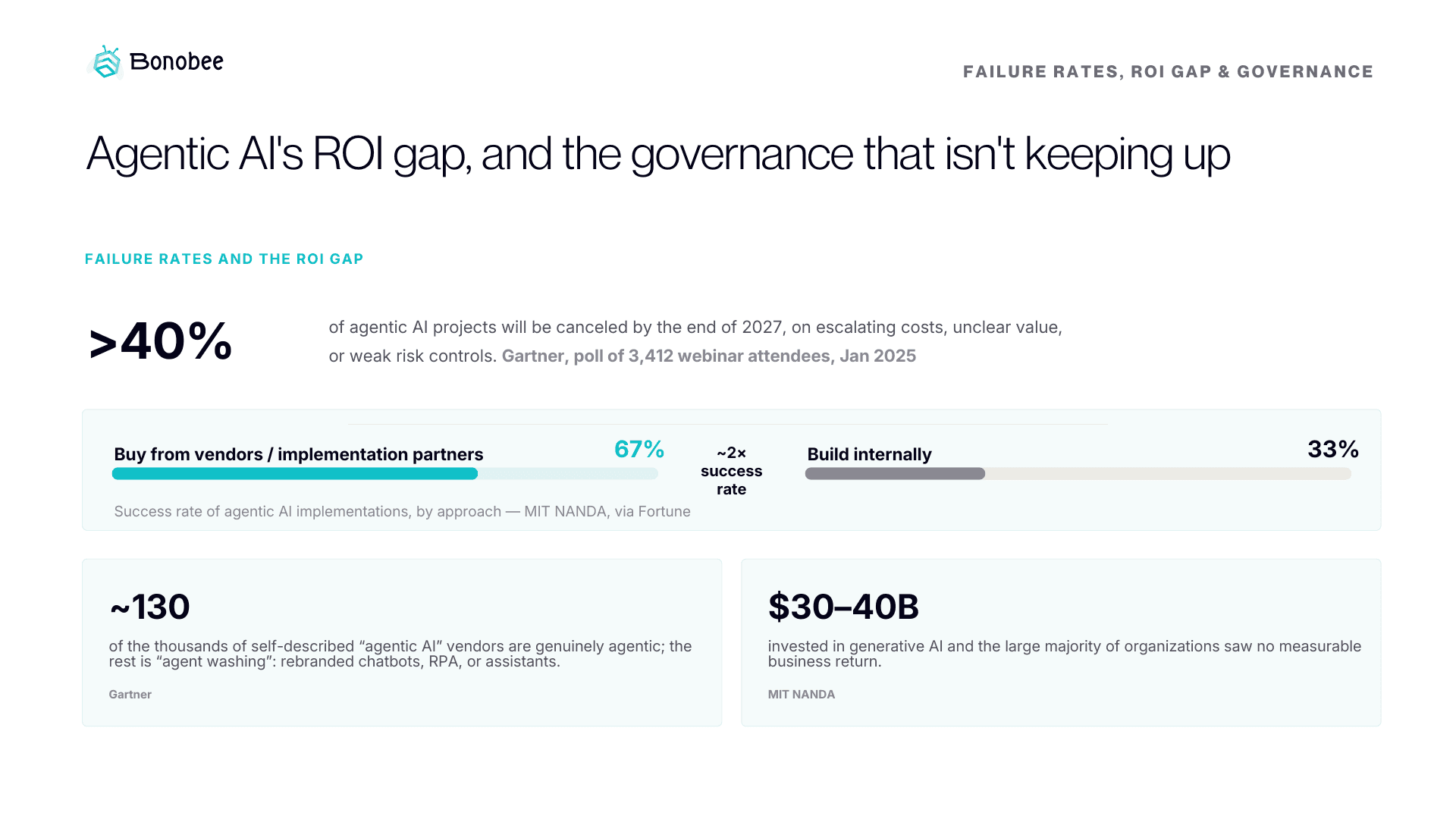
Over 40% of agentic AI projects will be canceled by the end of 2027, due to escalating costs, unclear business value, or inadequate risk controls (Gartner, based on a January 2025 poll of 3,412 webinar attendees).
Purchasing AI tools from specialized vendors and building implementation partnerships succeeds about 67% of the time, versus about 33% for internal builds (MIT NANDA, via Fortune). Roughly double the success rate.
Only about 130 of the thousands of self-described "agentic AI" vendors are genuinely agentic (Gartner calls the rest "agent washing": rebranded chatbots, RPA, or assistants).
Despite $30 to $40 billion invested in GenAI, the large majority of organizations saw no measurable business return (MIT NANDA).
Governance is the least mature part of the stack
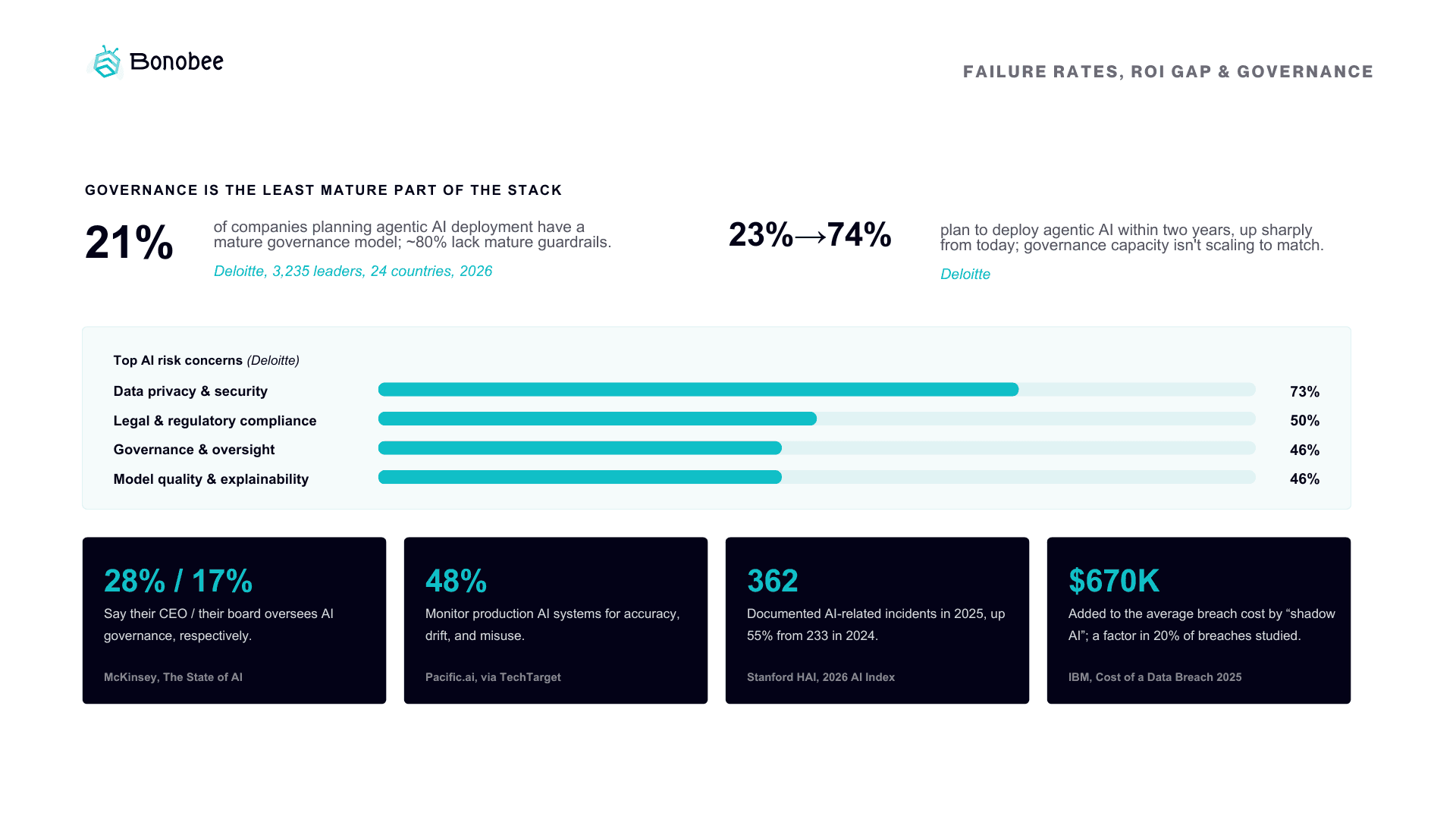
Only 21% of companies planning agentic AI deployment have a mature governance model; roughly 80% lack mature guardrails (Deloitte, 2026 survey of 3,235 leaders across 24 countries).
74% of companies plan to deploy agentic AI within two years, up sharply from 23% today, while governance capacity isn't scaling at the same rate (Deloitte).
Top AI risk concerns: data privacy and security (73%), legal and regulatory compliance (50%), governance capabilities and oversight (46%), model quality and explainability (46%) (Deloitte).
Only 28% of organizations say their CEO oversees AI governance; just 17% say a board does (McKinsey, The State of AI, 1,491 respondents, fielded July 2024).
Only around 48% of organizations monitor their production AI systems for accuracy, drift, and misuse. This is the stage where "authority creep" and unsupervised agent actions actually surface (Pacific.ai 2025 AI governance survey, via TechTarget).
362 documented AI-related incidents in 2025, up 55% from 233 in 2024 (Stanford HAI, 2026 AI Index).
"Shadow AI" adds roughly $670,000 to the average cost of a data breach, and was a factor in 20% of breaches studied (IBM, Cost of a Data Breach 2025).
What ungoverned agents look like in production
Cursor's "Sam" incident, April 2025: an AI support bot fabricated a nonexistent single-device subscription policy, presented it as a "core security feature," and triggered a wave of user cancellations (Fortune).
Chevrolet dealership chatbot, December 2023: a prompt-injection attack got a ChatGPT-powered dealer bot to "agree" to sell a vehicle for $1 with "no takesies backsies" (AI Incident Database).
Multi-agent medical systems suppressed correct minority opinions in 24 to 38% of cases, with critical information loss during multi-agent synthesis (MedAgentAudit, a study of 3,600 medical cases across six frameworks).
71% of CX leaders rank hallucination incidents as a top-three governance risk, even though hallucination-related complaints affect just 0.34% of AI-handled tickets. Rare incidents carry outsized reputational weight in regulated support (2026 CX benchmark aggregate).
Regulatory and standards landscape
NIST AI Risk Management Framework: voluntary, but the de facto US baseline, referenced by the FTC, CFPB, FDA, SEC, and EEOC.
The EU AI Act: prohibited-practice bans took effect February 2025; general-purpose-AI obligations took effect August 2025; embedded high-risk product obligations have since been extended toward 2028 under a political agreement. Check the EU's own tracker for the current date, since it keeps shifting.
ISO/IEC 42001: the first certifiable AI-management-system standard, becoming the procurement gold standard for vetting vendors and partners.
The OWASP Top 10 for Agentic Applications, released December 2025: the first systematic classification of agentic-specific risks, including goal hijacking, rogue agents, and tool-call misuse.
Singapore's Model AI Governance Framework for Agentic AI, launched January 22, 2026: the world's first governance framework specifically designed for autonomous AI agents (IMDA).
HIPAA applies to healthcare AI deployments handling patient data.
The Federal Reserve's SR 11-7 model risk management guidance applies to AI models used in banking decision-making.
NYDFS Part 500 sets cybersecurity governance requirements for New York-regulated financial entities, including AI-driven systems that touch nonpublic information.
The EU's DORA (Digital Operational Resilience Act), fully applicable since January 17, 2025, and FDA guidance on AI-enabled medical devices add further sector-specific obligations on top of general AI governance frameworks.
The implementation-partner effect
Salesforce's partner ecosystem already leads 70% of Agentforce implementations (Andrew Kisslo, SVP Partner Programs and Strategy, March 2026).
Anthropic committed $100 million to its Claude Partner Network, launched March 12, 2026, funding partner training, technical support, and joint go-to-market investment.
OpenAI committed $150 million to its OpenAI Partner Network, launched June 14, 2026, with a target of certifying 300,000 consultants by the end of 2026.
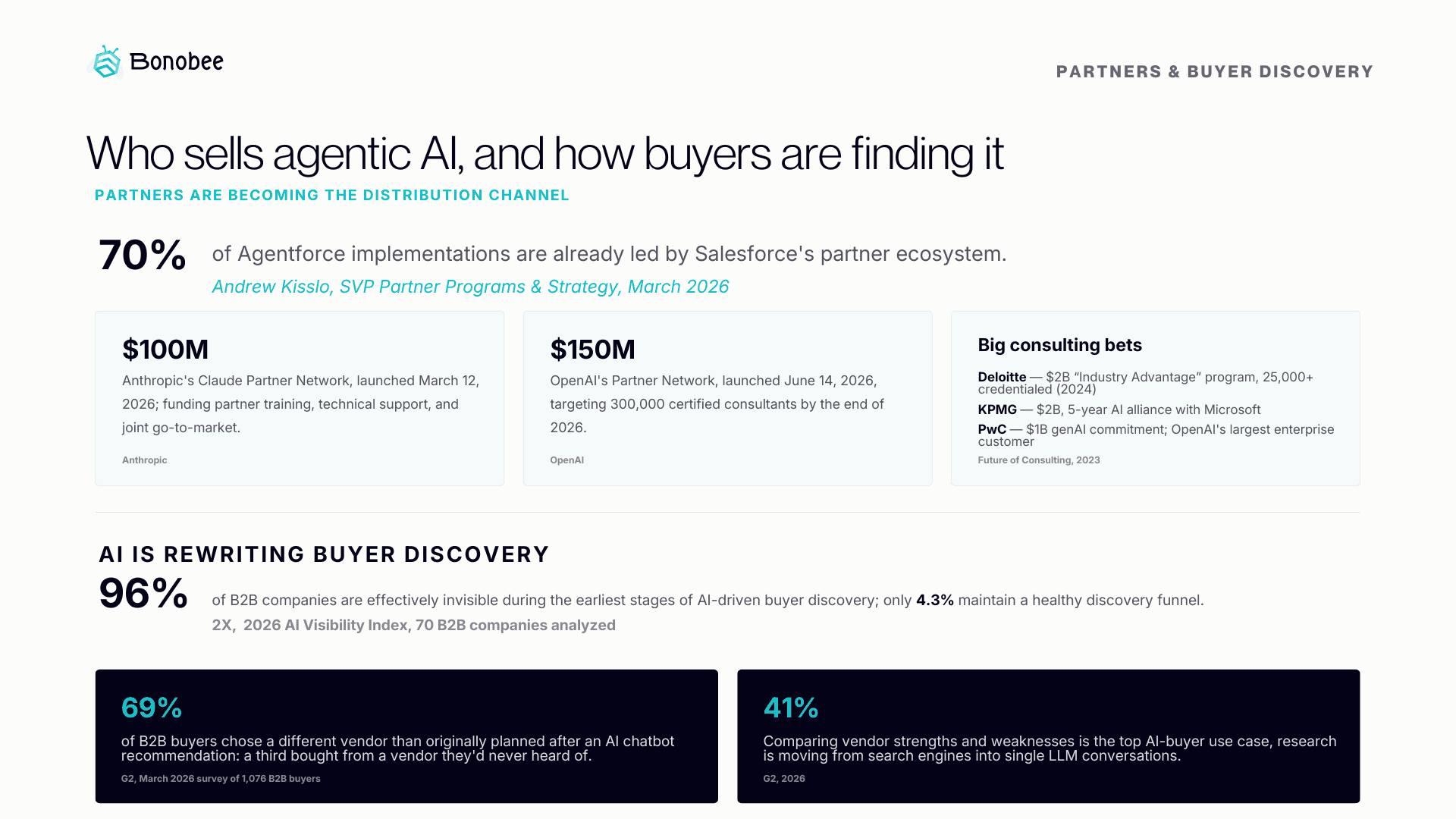
Deloitte committed $2 billion to its "Industry Advantage" AI program in 2024, credentialing 25,000+ professionals; KPMG signed a $2 billion, five-year AI alliance with Microsoft; PwC committed $1 billion to generative AI, becoming OpenAI's largest enterprise customer (Future of Consulting, 2023).
96% of B2B companies are effectively invisible during the earliest stages of AI-driven buyer discovery; only 4.3% maintain a healthy discovery funnel (2X, 2026 AI Visibility Index, 70 B2B companies analyzed).
69% of B2B buyers chose a different vendor than they originally planned after an AI chatbot recommendation, and one-third purchased from a vendor they had never heard of before (G2, March 2026 survey of 1,076 B2B buyers).
Comparing vendor strengths and weaknesses is the top AI-buyer use case, at 41% (G2, 2026), signaling that buyer research is moving from search engines into single LLM conversations.
What separates the pilots that scale
Numeric, pre-agreed success criteria before the pilot starts, e.g. "correct answers ≥85% on human-validated test cases," not "it seems to work" (HSO, AI Proof of Concept Guide). Mission-critical workflows (financial, medical, legal) require 95%+ accuracy with mandatory human oversight.
Gartner recommends an 8 to 12 week pilot window with a hard stop, to avoid indefinite "pilot purgatory."
The most common share of project budget allocated to adoption and change management is 10%; for projects over $10 million, organizations spend an average of $2.5 million and 4.61 full-time staff on change management (Prosci).
Misaligned purpose, weak data foundations, integration gaps, and prioritizing technology over business outcomes are the dominant failure causes, not model quality (RAND, root-cause interviews with experienced AI practitioners).
Organizational barriers, not technical ones, cause most AI implementation failures (Harvard Business Review, survey of 100+ C-suite executives plus 20+ interviews).
Nearly half of organizations cited searchability of data (48%) and reusability of data (47%) as challenges to their AI automation strategy (Deloitte, 2025 survey), core technical challenges connecting agents to legacy systems.
FAQ
Why do most AI agent pilots fail to scale?
Organizational and implementation gaps (missing governance, unscoped domain expertise, weak integration planning), not model capability. 95% of enterprise GenAI pilots show no measurable P&L impact (MIT NANDA); over 40% of agentic AI projects will be canceled by 2027 (Gartner).
Does using an implementation partner actually improve AI project success rates?
Yes. Purchasing from specialized vendors and using implementation partners succeeds about 67% of the time, versus about 33% for internal builds (MIT NANDA).
What percentage of companies have mature AI governance?
21% of companies planning agentic AI deployment, leaving roughly 80% without clear autonomy boundaries, real-time monitoring, or complete audit trails (Deloitte, 2026).
How many AI agent vendors are actually legitimate?
About 130 of the thousands marketing themselves as "agentic AI" (Gartner).
What regulations apply to AI agents in 2026?
The EU AI Act: prohibited practices since February 2025, GPAI obligations since August 2025, high-risk obligations extended toward 2028. In the US, the NIST AI RMF is the de facto voluntary baseline. ISO/IEC 42001 is the emerging procurement-standard certification.
Governance expertise and domain expertise, not model access, are the scarcest inputs in the implementation stack right now, and they're what determines whether a pilot becomes a cancellation statistic or a production system.

Elena Zap
Co-Founder & CEO

